
English
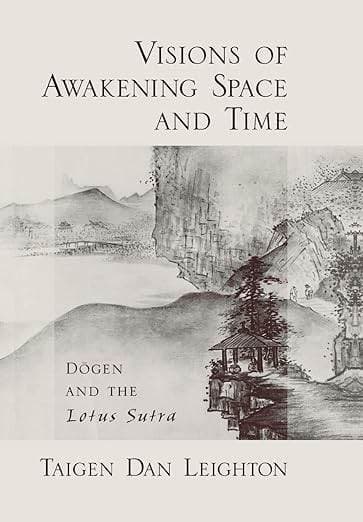
Visions of Awakening Space and Time: Dōgen and the Lotus Sutra
Taigen Dan Leighton
English
Book
Oxford University Press, New York
2007
206 pages
1.6 MB
Introduction
The book opens with a Preface that introduces one of the central images of the work: the bodhisattvas emerging from beneath the earth in chapter 15 of the Lotus Sutra. Leighton compares this scriptural image with the archaeological discovery of the Qin terracotta soldiers in China, using the comparison to highlight the symbolic power of beings emerging from the ground. The underground bodhisattvas, unlike the terracotta soldiers, are living agents of awakening who arise from the earth to preserve the Dharma into the distant future. This image becomes the interpretive key for the whole book: awakening is not simply an interior psychological state, but is connected with earth, space, time, embodiment, and the phenomenal world.
Chapter 1: The Pivotal Lotus Story and Dōgen’s Worldview
This chapter introduces the key narrative from chapters 15 and 16 of the Lotus Sutra. In chapter 15, countless bodhisattvas emerge from “the open space under the ground” to vow that they will preserve and teach the Lotus Dharma in the future. In chapter 16, Śākyamuni Buddha reveals that his life span is inconceivably long and that his apparent birth, awakening, and death are skillful means. Leighton explains that these chapters divide the sutra into its major structural sections: the earlier “trace teaching” and the later “origin teaching.” He then shows how Dōgen uses this Lotus narrative to express a radical view of reality: space itself can awaken, the earth can support practice, and time is not merely linear duration but an active dimension of realization.
Chapter 2: Hermeneutics and Discourse Styles in Studies of the Lotus Sutra and Dōgen
This chapter discusses how the Lotus Sutra and Dōgen should be interpreted. Leighton examines three major Mahāyāna hermeneutical principles: skillful means (upāya), Tathāgatagarbha or Buddha-womb/Buddha-nature teaching, and enactment practice. Skillful means explains why the Buddha teaches differently according to the capacities of beings. Tathāgatagarbha provides the basis for understanding awakening as immanent in reality. Enactment practice emphasizes that realization is not merely an intellectual understanding but must be embodied and performed through practice. The chapter also brings in Paul Ricoeur’s reflections on metaphor, proclamation, and interpretation to clarify Dōgen’s creative use of language.
Chapter 3: Selected East Asian Interpretations of the Story
This chapter surveys how major East Asian Buddhist figures interpreted the Lotus story of the underground bodhisattvas and the Buddha’s long life span. Leighton discusses early Chinese commentators such as Daosheng, Zhiyi, and Zhanran, as well as Japanese figures including Saigyō, Myōe, Nichiren, and later Zen figures such as Hakuin, Ryōkan, and Shunryū Suzuki. The chapter shows that the same Lotus narrative generated different religious meanings: Tiantai doctrinal classification, Nichiren’s eschatological mission, Zen practice interpretation, poetic imagination, and devotional response. This comparative approach helps situate Dōgen within a broader East Asian Lotus reception history.
Chapter 4: Dōgen’s Interpretations of This Lotus Sutra Story
This is the core chapter of the book. Leighton offers a close reading of Dōgen’s references to chapters 15 and 16 of the Lotus Sutra across his writings. The discussion is organized around earth, space, time, and the practical encouragement of students. Dōgen repeatedly draws on the image of underground bodhisattvas to express the deep support of the earth and the hidden availability of awakening. He also uses the Buddha’s inconceivable life span to articulate a non-linear, multidimensional understanding of time. For Dōgen, practice is not simply performed by an isolated individual; it is supported by the entire field of reality. Earth, space, and time are active participants in awakening.
Chapter 5: Dōgen’s View of Earth, Space, and Time Seen in Mahāyāna Context
This chapter places Dōgen’s worldview in the broader context of Mahāyāna Buddhism. Leighton discusses Buddhist imagery of earth and space, Buddha-nature discourse, Huayan interpenetration, Tiantai/Tendai thought, Zen tradition, and Mahāyāna perspectives on temporality. The chapter shows that although Dōgen’s treatment is distinctive, it is not isolated. His writings draw from and transform multiple Mahāyāna frameworks. Leighton also connects Dōgen’s view of time with the famous teaching of being-time (uji), arguing that Dōgen’s understanding of temporality cannot be separated from his view of space, earth, and practice.
Afterword: Implications of Dōgen’s Mahāyāna Worldview
The afterword reflects on the contemporary significance of Dōgen’s worldview. Leighton suggests that Dōgen’s vision has implications for modern concerns such as ecology, social engagement, and new understandings of reality in relation to contemporary physics. The point is not to reduce Dōgen to modern science, but to show that his Mahāyāna worldview challenges mechanistic, objectifying views of the world. If earth, space, and time are understood as active fields of awakening, then Buddhist practice has ethical implications for how human beings inhabit the planet and relate to the wider web of life.
The book concludes with Notes, Bibliography, and Index, making it a useful research resource for scholars of Dōgen, Zen, the Lotus Sutra, Mahāyāna hermeneutics, and Buddhist philosophy. Overall, the study demonstrates that Dōgen’s Zen cannot be properly understood apart from his deep engagement with the Lotus Sutra. It also shows that the Lotus Sutra was not merely a devotional scripture for Dōgen, but a fundamental source for his vision of awakened earth, awakened space, and awakened time.
Copyright Notice
This material is provided solely for academic research, study, and religious practice purposes under Article 25 of Vietnam's Intellectual Property Law. Reproduction, distribution, or commercial use is strictly prohibited.
If you are the author, translator, publisher, or rights holder and believe this content has been posted without proper authorization, please contact us and we will promptly review and remove or restrict access.
Documents
Visions of Awakening Space and Time: Dōgen and the Lotus Sutra
1.6 MB
Keywords
DōgenLotus SutraSōtō ZenSpace and TimeMahāyāna Hermeneutics.
Sách đọc nhiều nhất
The Buddha’s Ancient Path
Piyadassi Thera
Book·10.7 MB
229 pages1979223
The Questions of King Milinda, Part II
F. Max Müller (Editor)
Book·20.8 MB
427 pages1894208

A Taste of Freedom
Venerable Ajahn Chah / Phra Bodhinyana Thera
Book·1.2 MB
104 pages1980207
Buddhist Meditation: An Anthology of Texts from the Pāli Canon
Sarah Shaw (General Editors: Charles S. Prebish and Damien Keown)
Book·17.5 MB
253 pages2006204