
English
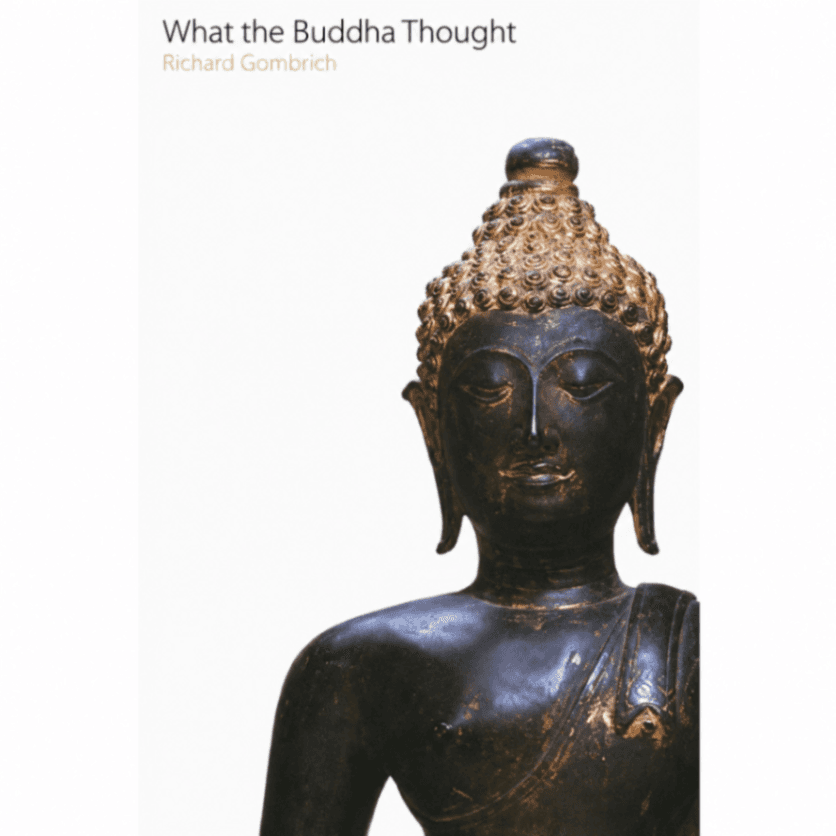
What the Buddha Thought
Richard Gombrich
English
Book
Equinox Publishing Ltd., London, United Kingdom
2009
237 pages
155.3 MB
Introduction
he book begins with a Preface in which Gombrich states his main purpose: to show that the Buddha was an exceptionally original thinker whose teachings must be understood through the historical and linguistic context of early India. The Background Information section introduces key languages, especially Sanskrit, Prakrit, and Pāli, as well as basic data on Buddhism, the Three Jewels, the Pāli Canon, and the historical setting of early Buddhist thought. Chapter 1, “Introduction,” clarifies the author’s method and warns against misunderstanding the Buddha through later doctrinal simplifications. Chapter 2, “More about Karma, and Its Social Context,” examines karma as intentional action and connects it to social responsibility. Chapter 3, “The Antecedents of the Karma Doctrine in Brahminism,” and Chapter 4, “Jain Antecedents,” analyze the pre-Buddhist background against which the Buddha’s ideas developed. Chapter 5, “What Did the Buddha Mean by ‘No Soul’?” explains the meaning of no-self in relation to continuity, identity, and experience. Chapter 6, “The Buddha’s Positive Values: Love and Compassion,” presents the ethical and affective dimensions of Buddhist teaching. Chapter 7, “Assessing the Evidence,” discusses how early Buddhist sources should be evaluated. Chapter 8, “Everything Is Burning: The Centrality of Fire in the Buddha’s Thought,” highlights fire imagery as a key interpretive framework. Chapter 9, “Causation and Non-random Process,” analyzes dependent causation and moral order. Chapter 10, “Cognition; Language; Nirvana,” studies the relationship between thought, expression, and liberation. Chapter 11, “The Buddha’s Pragmatism and Intellectual Style,” presents the Buddha as a strategic and practical thinker. Chapter 12, “The Buddha as Satirist; Brahmin Terms as Social Metaphors,” explains how the Buddha transformed Brahminical vocabulary. Chapter 13, “Is This Book To Be Believed?” reflects on the plausibility of the reconstruction, followed by an appendix on the Buddha’s appropriation of Brahminical terms, notes, bibliography, and index.
Copyright Notice
This material is provided solely for academic research, study, and religious practice purposes under Article 25 of Vietnam's Intellectual Property Law. Reproduction, distribution, or commercial use is strictly prohibited.
If you are the author, translator, publisher, or rights holder and believe this content has been posted without proper authorization, please contact us and we will promptly review and remove or restrict access.
Documents
What the Buddha Thought
155.3 MB
Keywords
Early BuddhismBuddha’s ThoughtKarmaNo-SelfNirvanaPāli CanonBuddhist Philosophy
Sách đọc nhiều nhất
The Buddha’s Ancient Path
Piyadassi Thera
Book·10.7 MB
229 pages1979223
The Questions of King Milinda, Part II
F. Max Müller (Editor)
Book·20.8 MB
427 pages1894208

A Taste of Freedom
Venerable Ajahn Chah / Phra Bodhinyana Thera
Book·1.2 MB
104 pages1980207
Buddhist Meditation: An Anthology of Texts from the Pāli Canon
Sarah Shaw (General Editors: Charles S. Prebish and Damien Keown)
Book·17.5 MB
253 pages2006204