
English
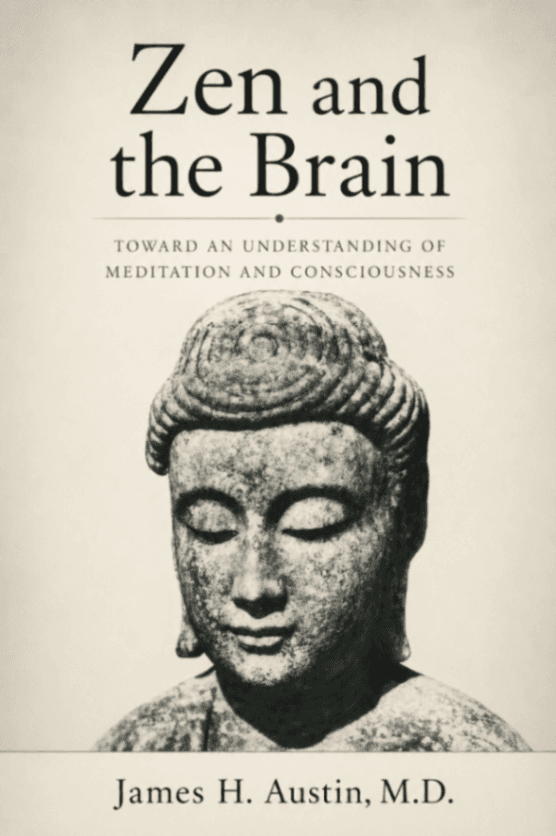
Zen and the Brain: Toward an Understanding of Meditation and Consciousness
James H. Austin, M.D.
English
Book
The MIT Press
1998
852 pages
7.6 MB
Introduction
The book is organized into eight major parts. Part I introduces the historical development, philosophy, and practice of Zen, examining its relationship to mysticism, religion, and neuroscience. Part II explains the physiological foundations of meditation, including breathing, posture, attention, and autonomic regulation. Part III surveys the neurobiology of the brain, discussing neurotransmitters, neural circuits, hemispheric specialization, memory, perception, and sensory processing. Part IV analyzes ordinary and altered states of consciousness, including sleep, dreams, absorption, imagery, psychedelic experiences, pain, near-death experiences, and temporal awareness. Parts V through VII investigate the neurological basis of advanced meditative experiences, including internal absorption, kenshō, insight, and enlightenment, proposing numerous testable neuroscientific hypotheses. Part VIII considers the enduring transformation associated with mature Zen practice, emphasizing compassion, ethical conduct, creativity, and the expression of enlightenment in everyday life.
Copyright Notice
This material is provided solely for academic research, study, and religious practice purposes under Article 25 of Vietnam's Intellectual Property Law. Reproduction, distribution, or commercial use is strictly prohibited.
If you are the author, translator, publisher, or rights holder and believe this content has been posted without proper authorization, please contact us and we will promptly review and remove or restrict access.
Documents
Zen and the Brain: Toward an Understanding of Meditation and Consciousness
7.6 MB
Keywords
Zen BuddhismNeuroscienceMeditationConsciousnessKenshōBrain FunctionContemplative Science.
Sách cùng tác giả
Sách đọc nhiều nhất
The Buddha’s Ancient Path
Piyadassi Thera
Book·10.7 MB
229 pages1979223
The Questions of King Milinda, Part II
F. Max Müller (Editor)
Book·20.8 MB
427 pages1894208

A Taste of Freedom
Venerable Ajahn Chah / Phra Bodhinyana Thera
Book·1.2 MB
104 pages1980207
Buddhist Meditation: An Anthology of Texts from the Pāli Canon
Sarah Shaw (General Editors: Charles S. Prebish and Damien Keown)
Book·17.5 MB
253 pages2006204