
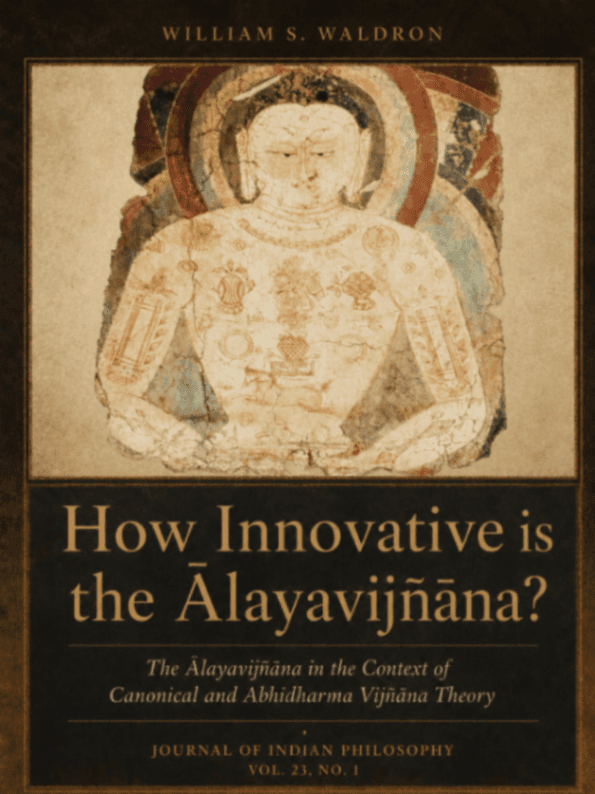
English
How Innovative is the Ālayavijñāna? The Ālayavijñāna in the Context of Canonical and Abhidharma Vijñāna Theory
William S. Waldron
English
Book
Journal of Indian Philosophy, Vol.23, No.1, pp.9-51
1995
43 pages
1.3 MB
Introduction
The article is organized into three major sections. The first section examines canonical conceptions of vijñāna, especially its role as consciousness, cognition, a condition within dependent origination, and a basis for saṃsāric continuity. The second section analyzes Abhidharma debates concerning momentariness and continuity, including karma, kleśa, seeds, bhavaṅga-citta, meditative cessation, and the difficulty of explaining long-term causal processes through momentary dharmas alone. The third section turns to Yogācāra sources such as the Yogācārabhūmi, Saṃdhinirmocana Sūtra, and Mahāyāna-saṃgraha, showing how ālayavijñāna was gradually systematized as a foundational consciousness that preserves karmic potential, supports the body-mind complex, and interacts with ordinary cognitive consciousnesses.
Copyright Notice
This material is provided solely for academic research, study, and religious practice purposes under Article 25 of Vietnam's Intellectual Property Law. Reproduction, distribution, or commercial use is strictly prohibited.
If you are the author, translator, publisher, or rights holder and believe this content has been posted without proper authorization, please contact us and we will promptly review and remove or restrict access.
Documents
How Innovative is the Ālayavijñāna? The Ālayavijñāna in the Context of Canonical and Abhidharma Vijñāna Theory
1.3 MB
Keywords
ĀlayavijñānaYogācāraVijñānaAbhidharmaKarmaLatent DispositionsBuddhist Philosophy.
Sách cùng tác giả
Sách đọc nhiều nhất
The Buddha’s Ancient Path
Piyadassi Thera
Book·10.7 MB
229 pages1979223
The Questions of King Milinda, Part II
F. Max Müller (Editor)
Book·20.8 MB
427 pages1894208

A Taste of Freedom
Venerable Ajahn Chah / Phra Bodhinyana Thera
Book·1.2 MB
104 pages1980207
Buddhist Meditation: An Anthology of Texts from the Pāli Canon
Sarah Shaw (General Editors: Charles S. Prebish and Damien Keown)
Book·17.5 MB
253 pages2006204