English
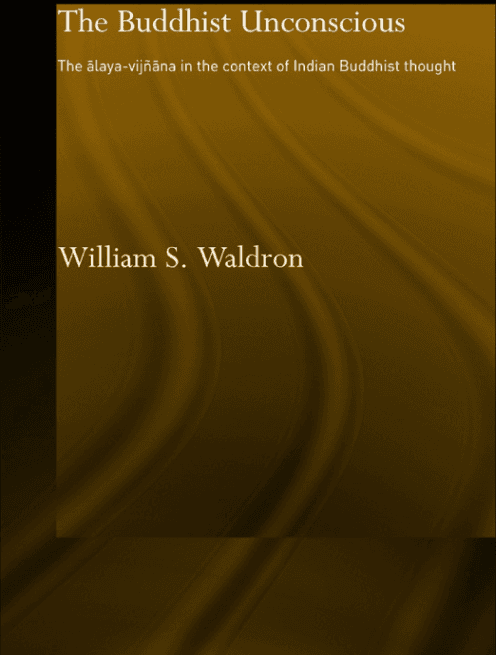
The Buddhist Unconscious: The Ālaya-vijñāna in the Context of Indian Buddhist Thought
William S. Waldron
English
Book
RoutledgeCurzon, Taylor & Francis Group, London and New York
2003
277 pages
1.5 MB
Introduction
The book opens with a thematic introduction that frames Buddhist thought as a critique of the constructed nature of “self” and “world.” Waldron explains how ordinary consciousness reifies subject and object, producing patterns of attachment, appropriation, conceptual proliferation, and saṃsāric repetition. This introduction establishes the philosophical need for a Buddhist account of unconscious conditioning.
Part I provides the doctrinal background of ālaya-vijñāna. The first chapter examines early Buddhist teachings on the three marks of existence, dependent arising, consciousness, karmic continuity, latent tendencies, and the reciprocal relationship between consciousness and karmic formations. The second chapter turns to Abhidharma, showing how its moment-by-moment analysis of mind created problems concerning the persistence of karmic seeds, latent afflictions, rebirth, and spiritual purification. This part is crucial because it demonstrates that ālaya-vijñāna did not emerge as an isolated Yogācāra invention, but as a response to long-standing Buddhist doctrinal tensions.
Part II analyzes the Yogācāra formulation of ālaya-vijñāna. Waldron first studies early Yogācāra sources, especially the Saṃdhinirmocana Sūtra and the Yogācārabhūmi, where ālaya-vijñāna is described as a subliminal stream of consciousness underlying manifest cognition. He then examines the Mahāyāna-saṃgraha, showing how Asaṅga’s system integrates karmic seeds, rebirth, afflictions, purification, and the relation between the individual mind-stream and shared world-experience. The discussion also explains the role of language, self-view, embodiment, and common experience in the Yogācāra model of mind.
Part III contains appendices, including a structured analysis of dependent arising, an index of related doctrinal controversies, and a translation of key portions of the Yogācārabhūmi. These materials support the book’s central thesis by providing technical documentation for the development of ālaya-vijñāna in Indian Buddhist scholastic thought.
Copyright Notice
This material is provided solely for academic research, study, and religious practice purposes under Article 25 of Vietnam's Intellectual Property Law. Reproduction, distribution, or commercial use is strictly prohibited.
If you are the author, translator, publisher, or rights holder and believe this content has been posted without proper authorization, please contact us and we will promptly review and remove or restrict access.
Documents
The Buddhist Unconscious: The Ālaya-vijñāna in the Context of Indian Buddhist Thought
1.5 MB
Keywords
Ālaya-vijñānaYogācāraBuddhist unconsciousAbhidharmaconsciousnesskarmic seedsBuddhist psychology.
Sách cùng tác giả

Sách đọc nhiều nhất
The Buddha’s Ancient Path
Piyadassi Thera
Book·10.7 MB
229 pages1979223
The Questions of King Milinda, Part II
F. Max Müller (Editor)
Book·20.8 MB
427 pages1894208

A Taste of Freedom
Venerable Ajahn Chah / Phra Bodhinyana Thera
Book·1.2 MB
104 pages1980207
Buddhist Meditation: An Anthology of Texts from the Pāli Canon
Sarah Shaw (General Editors: Charles S. Prebish and Damien Keown)
Book·17.5 MB
253 pages2006204