
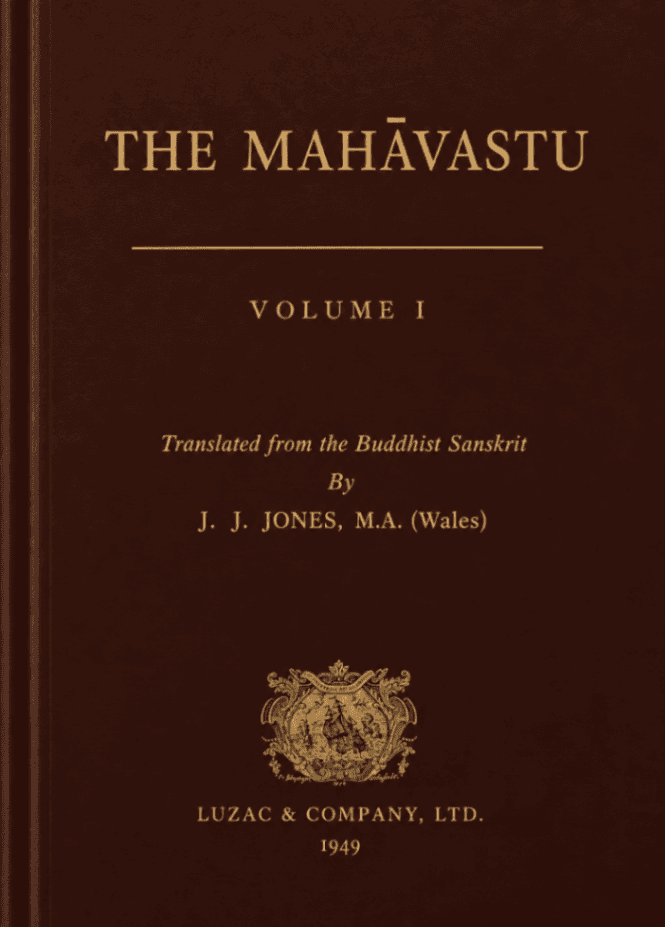
The Mahāvastu, Volume I
Introduction
The Mahāvastu is a crucial source for the study of the development of Buddhist biography, the Bodhisattva ideal, Buddhist narrative literature, and the transition from early Buddhist traditions toward later Mahāyāna thought. Although formally associated with the Vinaya of the Lokottaravādins, its surviving form is predominantly narrative rather than juridical. Its stories preserve memories of Śākyamuni’s previous lives, encounters with former Buddhas, predictions of future Buddhahood, cosmological journeys, Jātakas, avadānas, and doctrinal teachings. The heterogeneous and layered character of the work makes it particularly important for historical and philological research, because it preserves materials from different chronological strata and reveals how Buddhist communities progressively expanded the biography of the Buddha into a vast sacred history extending across innumerable lives and cosmic epochs. Volume I, with its emphasis on the distant career of the Bodhisattva and the Ten Bhūmis, is especially valuable for tracing the early formation of ideas that would later become fundamental to Mahāyāna Buddhist soteriology.
Volume I is primarily concerned with the remote past of the Buddha’s bodhisattva career. The Foreword explains that the first volume broadly corresponds to the Dūrenidāna pattern—the distant antecedents of the Buddha’s life—while later volumes move toward his birth, enlightenment, teaching career, and the establishment of the Saṅgha.
A substantial portion of the volume concerns cosmology and the bodhisattva path. The contents include Visits to Hell, Visits to Other Worlds, Many Buddhas, Visit to Śuddhāvāsa, and an extended treatment of the Ten Bhūmis, followed by separate discussions of each of the ten stages. These sections illustrate the developing conception of the Bodhisattva as a figure whose spiritual career unfolds across innumerable lives and encounters with previous Buddhas.
Another major section is devoted to Dīpaṃkara Buddha and the prophetic recognition of the future Śākyamuni. The stories of Dīpaṃkara, Megha, and Meghadatta belong to the broader Buddhist narrative tradition in which the Bodhisattva receives confirmation of his eventual attainment of Buddhahood. The volume further includes accounts of Buddha Maṅgala, visits to Vesālī, stories of former plagues, Mālinī, Ghaṭikāra and Jyotipāla, the genesis of the world, and the history of the Deer Park.
From the perspective of Buddhist doctrinal history, the Mahāvastu is especially valuable because it stands at an intersection between early Buddhist traditions and emerging Mahāyāna ideas. Its Lokottaravādin presentation stresses the supramundane (lokottara) character of the Buddha, while its elaboration of multiple Buddhas, Bodhisattvas, and the ten bhūmis anticipates themes that later become central to Mahāyāna Buddhism. At the same time, Jones observes that much of its doctrinal material remains close to teachings also preserved in non-Mahāyāna traditions.
Copyright Notice
This material is provided solely for academic research, study, and religious practice purposes under Article 25 of Vietnam's Intellectual Property Law. Reproduction, distribution, or commercial use is strictly prohibited.
If you are the author, translator, publisher, or rights holder and believe this content has been posted without proper authorization, please contact us and we will promptly review and remove or restrict access.
Documents
The Mahāvastu, Volume I
16.7 MB
Series: The Mahāvastu
Select a volume to see details or navigate between parts.
The Mahāvastu, Volume I
Keywords
Sách đọc nhiều nhất
The Buddha’s Ancient Path
Piyadassi Thera
The Questions of King Milinda, Part II
F. Max Müller (Editor)

A Taste of Freedom
Venerable Ajahn Chah / Phra Bodhinyana Thera
Buddhist Meditation: An Anthology of Texts from the Pāli Canon
Sarah Shaw (General Editors: Charles S. Prebish and Damien Keown)