
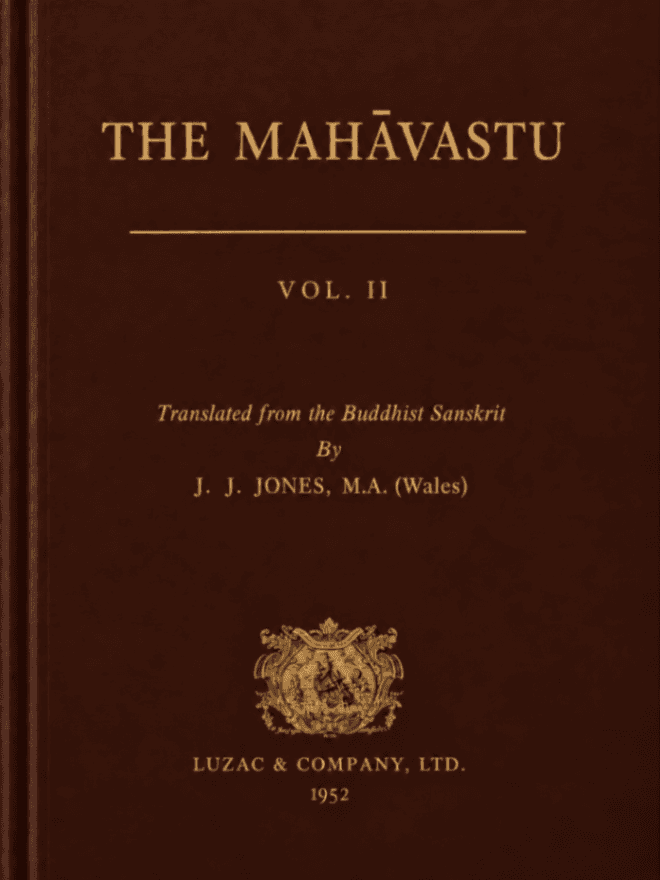
The Mahāvastu, Volume II
Introduction
Volume II of The Mahāvastu is especially important for reconstructing the literary development of the Buddha’s biography. It does not present a linear historical life of Gautama, but rather an accumulated body of traditions in which biographical episodes, Jātakas, Avadānas, sūtras, doctrinal passages, and devotional materials are interwoven. Jones emphasizes that the compilers sought comprehensiveness, incorporating virtually every tradition connected with the Buddha that came within their reach. As a result, repeated and sometimes divergent versions of the same episode frequently coexist within the work.
The volume opens with “Birth of Gotama,” presenting the Bodhisattva’s departure from Tuṣita heaven and his selection of the time, place, family, father, and mother appropriate for his final birth. The narrative describes Māyā’s purity, the Bodhisattva’s descent into her womb in the form of a white elephant, the intervention of devas and other supernatural beings, and the auspicious signs surrounding his conception and birth.
A striking characteristic of the narrative is its strongly supramundane portrayal of the Bodhisattva. His conception and birth are embedded within a cosmic drama involving devas, Nāgas, Yakṣas, Rākṣasas, Brahmā, Śakra, and celestial guardians. The Bodhisattva is represented not simply as an ordinary human being who later attains awakening, but as a being whose final descent into the human world is already invested with extraordinary qualities and universal religious significance.
Subsequent sections trace the development of the Buddha legend through accounts of Asita and the young Gotama, Gotama’s youth, his relationship with Yaśodharā, and the famous narratives concerning his marriage and courtship. These biographical sections are repeatedly interrupted or supplemented by Jātakas, including the Mañjarī, Godha, Amara, Siri, Syāma, Campaka, Syāmaka, Siriprabha, Śakuntaka, Kacchapa, Markaṭa, Surūpa, Anaṅgaṇa, and Kusa Jātakas.
The section on The Great Renunciation is especially important for Buddhist biography. It presents Gotama’s departure from household life as a decisive movement toward awakening, but the Mahāvastu does not offer this event as a single continuous narrative. Instead, it preserves multiple versions and associated stories, reflecting the compilatory character of the text. The contents accordingly contain both “The Great Renunciation” and “The Great Renunciation again.”
The subsequent accounts of Gotama’s early wanderings and Temptation by Māra move the narrative increasingly toward enlightenment. Particularly noteworthy are the two texts designated Avalokita-sūtra. Jones notes that these are effectively two independent sūtras dealing with events immediately preceding enlightenment and the defeat of Māra. The second also includes an extended passage describing the merit generated by offerings and acts of worship performed at Buddha stūpas, indicating an advanced development of Buddhist devotional practice.
Beyond its literary importance, the volume documents a major transformation in Buddhist religiosity: the gradual development from respect for an exemplary teacher toward increasingly elaborate veneration of the Buddha as a being of immeasurable power, purity, and cosmic significance. Jones explicitly identifies this development as one of the principal religious-historical reasons for studying the Mahāvastu.
Copyright Notice
This material is provided solely for academic research, study, and religious practice purposes under Article 25 of Vietnam's Intellectual Property Law. Reproduction, distribution, or commercial use is strictly prohibited.
If you are the author, translator, publisher, or rights holder and believe this content has been posted without proper authorization, please contact us and we will promptly review and remove or restrict access.
Documents
The Mahāvastu, Volume II
36.0 MB
Series: The Mahāvastu
Select a volume to see details or navigate between parts.
The Mahāvastu, Volume II
Keywords
Sách đọc nhiều nhất
The Buddha’s Ancient Path
Piyadassi Thera
The Questions of King Milinda, Part II
F. Max Müller (Editor)

A Taste of Freedom
Venerable Ajahn Chah / Phra Bodhinyana Thera
Buddhist Meditation: An Anthology of Texts from the Pāli Canon
Sarah Shaw (General Editors: Charles S. Prebish and Damien Keown)