
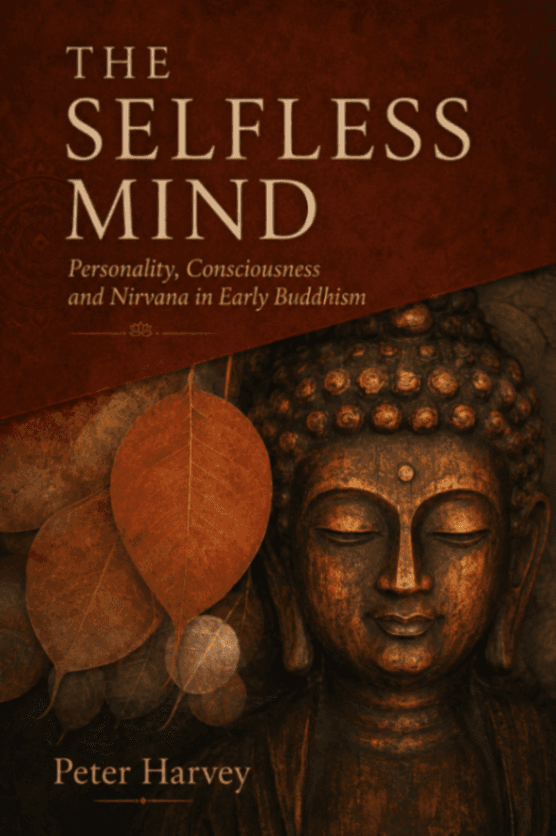
English
The Selfless Mind: Personality, Consciousness and Nirvana in Early Buddhism
Peter Harvey
English
Book
Curzon Press, Richmond, Surrey
1995
282 pages
53.1 MB
Introduction
The book is organized into two major parts. Part I, “Exploring the Notion of Selflessness,” examines the question of Self, the meaning of “not-Self,” the Buddhist critique of metaphysical selfhood, the criteria for selfhood, the role of the “I am” attitude, the development of a self without boundaries, personal continuity, responsibility across lives, the relation between world and self, and debates over the life-principle and the between-lives state. Part II, “Saṃsāric and Nibbānic Discernment,” turns to the dynamics of consciousness and liberation, analyzing the centrality of discernment, conditioned arising, the perceptual process, the nature of viññāṇa, bhavaṅga and the brightly shining mind, nibbāna as timeless stopping, nibbāna as a transformed state of discernment, and the status of the tathāgata. The conclusion draws these themes together by presenting early Buddhist selflessness as a rigorous analysis of conditioned personality, karmic continuity, consciousness, and liberation, in which freedom is achieved not by discovering a permanent Self, but by ending attachment to the processes wrongly appropriated as self.
Copyright Notice
This material is provided solely for academic research, study, and religious practice purposes under Article 25 of Vietnam's Intellectual Property Law. Reproduction, distribution, or commercial use is strictly prohibited.
If you are the author, translator, publisher, or rights holder and believe this content has been posted without proper authorization, please contact us and we will promptly review and remove or restrict access.
Documents
The Selfless Mind: Personality, Consciousness and Nirvana in Early Buddhism
53.1 MB
Keywords
anattāearly Buddhismpersonalityconsciousnessnibbānacittatathāgata.
Sách cùng tác giả
Vinaya Principles for Assigning Degrees of Culpability
Peter Harvey
Journal·170 KB
21 pages199958
Ethics in Early Buddhism
Peter Harvey
Journal·193 KB
11 pages1996133
An Introduction to Buddhist Ethics: Foundations, Values and Issues
Peter Harvey
Book·8.2 MB
500 pages2000145
An Introduction to Buddhism: Teachings, History and Practices
Peter Harvey
Book·280.1 MB
344 pages2004140
Sách đọc nhiều nhất
The Buddha’s Ancient Path
Piyadassi Thera
Book·10.7 MB
229 pages1979223
The Questions of King Milinda, Part II
F. Max Müller (Editor)
Book·20.8 MB
427 pages1894208

A Taste of Freedom
Venerable Ajahn Chah / Phra Bodhinyana Thera
Book·1.2 MB
104 pages1980207
Buddhist Meditation: An Anthology of Texts from the Pāli Canon
Sarah Shaw (General Editors: Charles S. Prebish and Damien Keown)
Book·17.5 MB
253 pages2006204