English
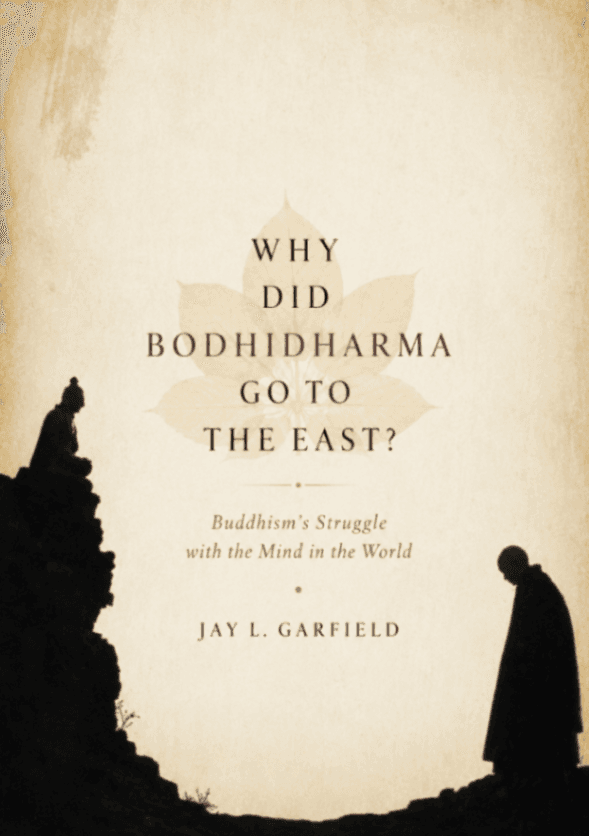
Why Did Bodhidharma Go to the East?
Jay L. Garfield
English
Book
Sophia, Vol. 45, No. 2; Ashgate Publishing Limited. City of publication
2006
20 pages
1.2 MB
Introduction
The article begins by contrasting Indian and Chinese conceptual frameworks concerning mind, language, and world, arguing that Indian Buddhist philosophy inherited a representational model in which language expresses thought and thought represents objects, while classical Chinese thought treated language more as a guiding discourse than as a representation of inner mental content. It then examines Buddhist epistemology through the distinction between direct perception and inference, showing how perception is treated as more fully authoritative while inference remains conventionally useful but ultimately dependent on conceptual constructions. Garfield next discusses conceptual and non-conceptual thought, explaining how ordinary cognition fabricates objects through concepts, whereas enlightened cognition is described as non-conceptual. The article then turns to non-duality, showing how ordinary consciousness divides subject and object, object and complement, characteristic and characterized, while awakened awareness transcends these dualistic structures. The discussion of awareness and representation develops the claim that ordinary cognition is mediated by representations, whereas a Buddha’s cognition is non-representational and immediate. The section on Yogācāra introduces the three natures, foundation consciousness, transformation of the basis, and Buddha-nature as attempts to explain how ordinary deluded cognition can be transformed into enlightened awareness. Finally, the article argues that when Buddhism entered China, these ideas found a more congenial intellectual setting, allowing Chan/Zen traditions to articulate the Buddhist critique of conceptuality, representation, and dualism with distinctive clarity.
Copyright Notice
This material is provided solely for academic research, study, and religious practice purposes under Article 25 of Vietnam's Intellectual Property Law. Reproduction, distribution, or commercial use is strictly prohibited.
If you are the author, translator, publisher, or rights holder and believe this content has been posted without proper authorization, please contact us and we will promptly review and remove or restrict access.
Documents
Why Did Bodhidharma Go to the East?
1.2 MB
Keywords
BodhidharmaChan Buddhismphilosophy of mindYogācāraMadhyamakanon-dualityBuddhist epistemology
Sách cùng tác giả
Sách đọc nhiều nhất
The Buddha’s Ancient Path
Piyadassi Thera
Book·10.7 MB
229 pages1979223
The Questions of King Milinda, Part II
F. Max Müller (Editor)
Book·20.8 MB
427 pages1894208

A Taste of Freedom
Venerable Ajahn Chah / Phra Bodhinyana Thera
Book·1.2 MB
104 pages1980207
Buddhist Meditation: An Anthology of Texts from the Pāli Canon
Sarah Shaw (General Editors: Charles S. Prebish and Damien Keown)
Book·17.5 MB
253 pages2006204