Introduction
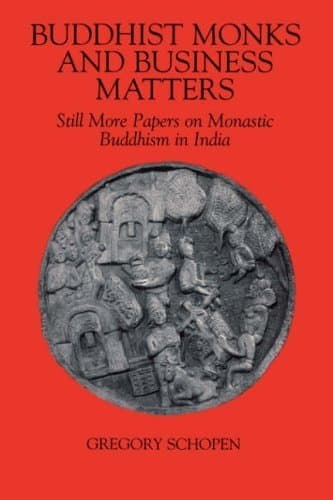
The book begins with a Preface by Donald S. Lopez, Jr., who situates Gregory Schopen’s work as a major methodological intervention in Buddhist Studies. Lopez explains that Schopen’s research redirects attention away from the exclusive study of elite scholastic texts and toward archaeological, epigraphical, and material evidence. This shift allows scholars to see forms of Buddhist practice that were previously dismissed as “popular” or marginal, but were in fact central to the lived world of Indian Buddhist communities.
The volume contains twelve chapters, each originally published as a scholarly paper and slightly revised for consistency. Together, these chapters examine the social, ritual, and material life of Indian Buddhist monasticism.
Chapter I: Archaeology and Protestant Presuppositions in the Study of Indian Buddhism
This chapter criticizes the dominant textual bias in Buddhist Studies. Schopen argues that modern scholars have often privileged canonical texts over archaeological and epigraphical evidence, even though material evidence may better reflect what Buddhists actually practiced. He challenges the assumption that normative scriptures automatically describe historical reality. This chapter functions as the methodological foundation for the whole book.
Chapter II: Two Problems in the History of Indian Buddhism: The Layman/Monk Distinction and the Doctrines of the Transference of Merit
This chapter questions the sharp distinction often made between lay and monastic religious activity. Schopen examines inscriptions and textual materials to show that monks were not merely passive recipients of lay merit-making. They also participated in practices such as donation and merit transfer. The chapter is particularly relevant for the study of dāna, puṇya/puñña, and the social economy of merit.
Chapter III: Filial Piety and the Monk in the Practice of Indian Buddhism: A Question of “Sinicization” Viewed from the Other Side
Here Schopen challenges the assumption that filial piety entered Buddhism mainly through Chinese cultural influence. By examining Indian Buddhist evidence, he shows that concern for parents, ancestors, and deceased relatives was already part of Indian Buddhist monastic practice. This chapter is important for reassessing the relationship between Indian Buddhism and East Asian Buddhism.
Chapter IV: The Ritual Obligations and Donor Roles of Monks in the Pāli Vinaya
This chapter studies the Pāli Vinaya to show that monks were not only recipients of gifts but could also act as donors and ritual agents. Schopen demonstrates that the Vinaya preserves evidence of monks participating in donation-related activities, which complicates the simplified image of monks as world-renouncing figures detached from material and ritual exchange.
Chapter V: The Stūpa Cult and the Extant Pāli Vinaya
This chapter examines the relationship between the stūpa cult and the Pāli Vinaya. Schopen argues that relic and stūpa worship cannot be treated as later, merely popular, or non-monastic developments. Instead, the evidence suggests that monastic communities were deeply involved in stūpa-related ritual life.
Chapter VI: Monks and the Relic Cult in the Mahāparinibbāna-sutta: An Old Misunderstanding in Regard to Monastic Buddhism
This chapter revisits the Mahāparinibbāna-sutta and its treatment of relics. Schopen challenges older interpretations that separated monks from relic devotion. He argues that relic veneration and monastic Buddhism were not opposed; rather, relic cults were embedded in monastic institutions and ritual practices.
Chapter VII: Burial Ad Sanctos and the Physical Presence of the Buddha in Early Indian Buddhism: A Study in the Archaeology of Religions
This chapter explores the practice of burial near sacred remains or sacred spaces. Schopen examines how proximity to relics and sacred sites expressed ideas of sanctity, protection, and religious presence. The chapter highlights the importance of the Buddha’s physical presence through relics in early Indian Buddhist religious life.
Chapter VIII: On the Buddha and His Bones: The Conception of a Relic in the Inscriptions from Nāgārjunikoṇḍa
This chapter studies inscriptions from Nāgārjunikoṇḍa to analyze how Buddhist relics were conceptualized. Schopen shows that relics were not treated merely as symbolic reminders of the Buddha, but as powerful physical presences. This chapter is central for understanding Buddhist relic theory through inscriptional evidence.
Chapter IX: An Old Inscription from Amarāvatī and the Cult of the Local Monastic Dead in Indian Buddhist Monasteries
This chapter examines an inscription from Amarāvatī and uses it to discuss the cult of deceased monastics within Indian Buddhist monasteries. Schopen argues that Buddhist monasteries preserved and venerated not only relics of the Buddha but also the remains of local monastic figures.
Chapter X: On Avoiding Ghosts and Social Censure: Monastic Funerals in the Mūlasarvāstivāda-vinaya
This chapter focuses on monastic funerals. Schopen uses the Mūlasarvāstivāda Vinaya to show that Buddhist monastic communities had detailed concerns about death, funerary obligations, ghosts, public reputation, and proper ritual conduct. It directly challenges the idea that early Buddhist monasticism had little interest in funerary practice.
Chapter XI: On Monks, Nuns, and “Vulgar” Practices: The Introduction of the Image Cult into Indian Buddhism
This chapter studies the role of monks and nuns in the rise of Buddhist image worship. Schopen challenges the claim that image cults were merely lay or “popular” practices. Instead, he shows that monastics were actively involved in introducing and sustaining image-related devotion.
Chapter XII: The Buddha as an Owner of Property and Permanent Resident in Medieval Indian Monasteries
The final chapter examines the striking idea that the Buddha could be treated as a property holder and permanent resident within medieval Indian monasteries. Schopen analyzes how monastic legal and ritual systems could imagine the Buddha as an institutional presence with economic and juridical implications.
The book concludes with several research tools: Index of Archaeological Sites and Inscriptions, Index of Texts, Index of Words, Phrases, and Formulae, and Index of Subjects. These indexes reinforce the book’s value as a specialized reference work for the study of Indian Buddhist monasticism, epigraphy, archaeology, Vinaya, relics, stūpas, and ritual practice.