
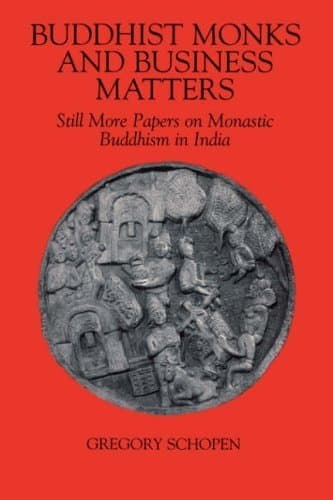
English
Buddhist Monks and Business Matters: Still More Papers on Monastic Buddhism in India
Gregory Schopen
English
Book
University of Hawai‘i Press, Honolulu.
2004
150 pages
31.1 MB
Introduction
The book contains fourteen chapters, followed by indexes of archaeological sites and texts, and a general subject index.
Chapter I: The Good Monk and His Money in a Buddhist Monasticism of “the Mahāyāna Period”
This chapter challenges the assumption that Indian Buddhist monks had no relation to money or private property. Schopen argues that textual and institutional evidence from the Mūlasarvāstivāda tradition shows monks dealing with money, personal property, medicine expenses, debts, inheritance, and economic obligations. The chapter is important because it critiques the romantic image of the monk as entirely detached from material affairs and reconstructs a more historically grounded picture of monastic life.
Chapter II: Art, Beauty, and the Business of Running a Buddhist Monastery in Early Northwest India
This chapter studies the aesthetic and administrative dimensions of monastery management. Schopen shows that Buddhist monasteries in Northwest India were not only religious spaces but also carefully maintained institutional environments. Monks were involved in receiving donations, maintaining buildings, commissioning or managing visual culture, and ensuring that monasteries remained attractive to donors and residents. The chapter links art, beauty, patronage, and monastic economy.
Chapter III: Doing Business for the Lord: Lending on Interest and Written Loan Contracts in the Mūlasarvāstivāda-vinaya
This chapter examines loan practices, written contracts, and interest-bearing transactions in Buddhist monastic law. Schopen analyzes passages showing that monasteries could receive permanent endowments and lend money on interest for institutional purposes. The chapter is particularly significant for Buddhist economic history because it demonstrates that monastic communities used formal legal and financial instruments.
Chapter IV: Deaths, Funerals, and the Division of Property in a Monastic Code
This chapter studies death and inheritance in the monastic community. It discusses what happens to a monk’s property after death and how the monastic code regulates funerals, estate division, and claims over possessions. The chapter shows that Buddhist monasticism developed practical legal rules for handling property, debts, ritual obligations, and disputes after death.
Chapter V: Dead Monks and Bad Debts: Some Provisions of a Buddhist Monastic Inheritance Law
This chapter continues the analysis of monastic inheritance by focusing on debt, property rights, and estate management. Schopen shows that the Vinaya includes detailed provisions for situations involving deceased monks, unpaid debts, and disputed property. This complicates the idea that monks possessed nothing or that monastic institutions were economically simple.
Chapter VI: Monastic Law Meets the Real World: A Monk’s Continuing Right to Inherit Family Property in Classical India
This chapter examines the legal relationship between ordination and family property. Schopen argues that becoming a monk did not necessarily sever all legal ties to family inheritance. The chapter is important for understanding how Buddhist monastic identity interacted with broader Indian legal norms concerning kinship, property, and inheritance.
Chapter VII: The Monastic Ownership of Servants or Slaves: Local and Legal Factors in the Redactional History of Two Vinayas
This chapter studies references to monastic ownership or control of servants and slaves. Schopen investigates how different Vinaya traditions handled these issues and how local legal realities may have shaped textual redaction. The chapter is important because it reveals the monastery as a complex social institution embedded in labor systems and local legal cultures.
Chapter VIII: The Lay Ownership of Monasteries and the Role of the Monk in Mūlasarvāstivādin Monasticism
This chapter examines the relationship between lay donors and monastic property. Schopen shows that monasteries could involve layered ownership structures, in which lay donors, monastic communities, and individual monks each had defined roles. The chapter is highly relevant to the study of dāna because it analyzes how donated property was legally conceptualized and institutionally managed.
Chapter IX: Marking Time in Buddhist Monasteries: On Calendars, Clocks, and Some Liturgical Practices
This chapter studies timekeeping in Buddhist monasteries. Schopen discusses calendars, ritual schedules, clocks, and liturgical coordination. The chapter shows that monastic life required organized temporal discipline, not only for meditation or study but also for ritual observance, administration, and communal order.
Chapter X: Ritual Rights and Bones of Contention: More on Monastic Funerals and Relics in the Mūlasarvāstivāda-vinaya
This chapter returns to funerary ritual and relics. Schopen examines disputes over ritual rights, relic treatment, and the handling of monastic remains. The chapter contributes to the broader argument that monks were deeply involved in funerary, relic, and memorial practices, contrary to the assumption that such practices were merely lay or popular Buddhism.
Chapter XI: The Suppression of Nuns and the Ritual Murder of Their Special Dead in Two Buddhist Monastic Codes
This chapter addresses the treatment of nuns and their deceased within Buddhist monastic legal texts. Schopen examines gendered asymmetries in ritual and institutional regulations. The chapter is important for the study of Buddhist nuns, monastic hierarchy, and the legal construction of gender within Vinaya traditions.
Chapter XII: Immigrant Monks and the Protohistorical Dead: The Buddhist Occupation of Early Burial Sites in India
This chapter explores the relationship between Buddhist monastic expansion and earlier burial landscapes. Schopen analyzes how Buddhist monks occupied, reinterpreted, or interacted with pre-existing mortuary sites. The chapter brings archaeology into conversation with monastic history and shows how Buddhist institutions were established within older sacred or funerary geographies.
Chapter XIII: What’s in a Name: The Religious Function of the Early Donative Inscriptions
This chapter examines early Buddhist donative inscriptions. Schopen argues that names in inscriptions were not merely administrative labels; they had religious function. Recording the donor’s name, gift, and institutional affiliation participated in a broader religious economy of memory, merit, and public recognition. This chapter is directly useful for research on dāna and merit.
Chapter XIV: If You Can’t Remember, How to Make It Up: Some Monastic Rules for Redacting Canonical Texts
The final chapter examines how monastic communities handled memory, textual redaction, and canonical transmission. Schopen studies rules for reconstructing or redacting texts when memory failed. This chapter highlights the institutional and procedural dimensions of Buddhist textual preservation.
Copyright Notice
This material is provided solely for academic research, study, and religious practice purposes under Article 25 of Vietnam's Intellectual Property Law. Reproduction, distribution, or commercial use is strictly prohibited.
If you are the author, translator, publisher, or rights holder and believe this content has been posted without proper authorization, please contact us and we will promptly review and remove or restrict access.
Documents
Buddhist Monks and Business Matters: Still More Papers on Monastic Buddhism in India
31.1 MB
Keywords
Buddhist MonasticismMonastic EconomyMūlasarvāstivāda-vinayaBuddhist Property Law
Sách cùng tác giả

Figments and Fragments of Mahāyāna Buddhism in India: More Collected Papers
Gregory Schopen
Book·8.0 MB
410 pages2005160
Buddhist Nuns, Monks, and Other Worldly Matters: Recent Papers on Monastic Buddhism in India
Gregory Schopen
Book·3.1 MB
480 pages2014189
Bones, Stones, and Buddhist Monks: Collected Papers on the Archaeology, Epigraphy, and Texts of Monastic Buddhism in India
Gregory Schopen
Book·16.7 MB
311 pages119
Sách đọc nhiều nhất
The Buddha’s Ancient Path
Piyadassi Thera
Book·10.7 MB
229 pages1979223
The Questions of King Milinda, Part II
F. Max Müller (Editor)
Book·20.8 MB
427 pages1894208

A Taste of Freedom
Venerable Ajahn Chah / Phra Bodhinyana Thera
Book·1.2 MB
104 pages1980207
Buddhist Meditation: An Anthology of Texts from the Pāli Canon
Sarah Shaw (General Editors: Charles S. Prebish and Damien Keown)
Book·17.5 MB
253 pages2006204