
English
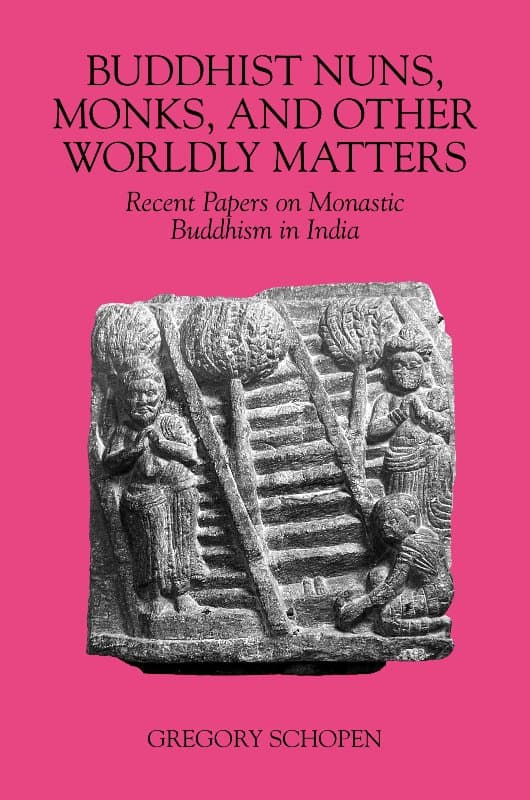
Buddhist Nuns, Monks, and Other Worldly Matters: Recent Papers on Monastic Buddhism in India
Gregory Schopen
English
Book
University of Hawai‘i Press, Honolulu
2014
480 pages
3.1 MB
Introduction
The book is organized into three major parts: Nuns, Monks, and Other, comprising nineteen chapters.
Part I: Nuns
Chapter I: The Urban Buddhist Nun and a Protective Rite for Children in Early North India
This chapter argues that the urban location of Buddhist nunneries has been overlooked. Schopen examines Mūlasarvāstivāda-vinaya materials showing that nuns were prohibited from living in the forest and that their residences should be located inside towns or cities. The chapter also studies a protective rite for children and the figure of the nun Sthūlanandā, suggesting that Buddhist nuns interacted closely with urban religious and social practices.
Chapter II: On Emptying Chamber Pots without Looking and the Urban Location of Buddhist Nunneries in Early India Again
This chapter continues the argument that Buddhist nunneries were urban institutions. Schopen uses apparently minor Vinaya rules to reconstruct the daily spatial and social setting of nuns, showing how even mundane regulations can reveal institutional geography.
Chapter III: On Incompetent Monks and Able Urbane Nuns in a Buddhist Monastic Code
This chapter contrasts the representation of monks and nuns in monastic legal materials. Schopen draws attention to narratives in which nuns appear capable, practical, and socially competent, while some monks are shown as ineffective or dependent.
Chapter IV: Separate but Equal: Property Rights and the Legal Independence of Buddhist Nuns and Monks in Early North India
This chapter examines the legal status of nuns and monks in relation to property. Schopen argues that Buddhist nuns could possess property rights and legal independence within monastic codes, challenging assumptions that women’s monastic institutions were merely subordinate to male ones.
Chapter V: On the Legal and Economic Activities of Buddhist Nuns: Two Examples from Early India
This chapter studies specific cases of nuns engaging in legal and economic activity. It contributes to Schopen’s broader thesis that Buddhist monasticism cannot be understood only through renunciation; it must also be studied through institutional transactions, property, and legal agency.
Chapter VI: The Buddhist Nun as an Urban Landlord and a “Legal Person” in Early India
This chapter presents Buddhist nuns as legal actors capable of owning, managing, or administering property in an urban context. The chapter is especially significant for the study of Buddhist women, because it shows nuns functioning as institutional agents within economic and juridical frameworks.
Chapter VII: A New Hat for Hārītī: On “Giving” Children for Their Protection to Buddhist Nuns and Monks in Early India
This chapter examines protective rites involving children and the goddess Hārītī. Schopen studies the religious logic of “giving” children to Buddhist nuns and monks for protection, showing how Buddhist institutions interacted with local cults, family anxieties, and ritual guardianship.
Chapter VIII: On Some Who Are Not Allowed to Become Buddhist Monks or Nuns: An Old List of Types of Slaves or Unfree Laborers
This chapter analyzes categories of people excluded from ordination, especially slaves and unfree laborers. It is important for understanding how Buddhist monastic law interacted with social hierarchy, labor status, and legal dependency in early India.
Part II: Monks
Chapter IX: Making Men into Monks
This chapter studies the process of ordination and the institutional transformation of laymen into Buddhist monks. Schopen focuses on the legal, ritual, and procedural mechanisms through which monastic identity is created.
Chapter X: Counting the Buddha and the Local Spirits In: A Monastic Ritual of Inclusion for the Rain Retreat
This chapter examines a ritual connected with the rain retreat. Schopen shows that monastic ritual life included not only monks but also the Buddha and local spirits, revealing the layered religious environment in which monasteries functioned.
Chapter XI: The Buddhist “Monastery” and the Indian Garden: Aesthetics, Assimilations, and the Siting of Monastic Establishments
This chapter studies the relationship between monasteries and gardens. Schopen argues that Buddhist monastic sites were not merely austere retreats but were often shaped by aesthetic, environmental, and cultural ideas associated with gardens and pleasure spaces.
Chapter XII: On Monks and Menial Laborers: Some Monastic Accounts of Building Buddhist Monasteries
This chapter analyzes labor and construction in Buddhist monastic settings. It examines how monasteries were built, who performed the labor, and how monastic codes handled the presence of workers, servants, and laborers.
Chapter XIII: A Well-Sanitized Shroud: Asceticism and Institutional Values in the Middle Period of Buddhist Monasticism
This chapter explores the tension between ascetic ideals and institutional norms. Through the motif of the shroud, Schopen studies how Buddhist monasticism negotiated austerity, cleanliness, ritual propriety, and institutional discipline.
Chapter XIV: The Buddhist Bhikṣu’s Obligation to Support His Parents in Two Vinaya Traditions
This chapter challenges the idea that monks were completely detached from family obligations. Schopen examines Vinaya materials showing that monks could retain duties toward their parents, thereby complicating the assumed opposition between renunciation and filial responsibility.
Chapter XV: On Buddhist Monks and Dreadful Deities: Some Monastic Devices for Updating the Dharma
This chapter examines the interaction between Buddhist monks and local or fearsome deities. Schopen shows how monastic traditions adapted to changing religious environments by incorporating or responding to non-Buddhist divine figures.
Part III: Other
Chapter XVI: Celebrating Odd Moments: The Biography of the Buddha in Some Mūlasarvāstivādin Cycles of Religious Festivals
This chapter studies religious festivals connected with episodes in the Buddha’s biography. Schopen shows how biography, ritual calendar, and monastic observance intersect in Mūlasarvāstivādin materials.
Chapter XVII: Taking the Bodhisattva into Town: More Texts on the Image of “the Bodhisattva” and Image Processions in the Mūlasarvāstivāda-vinaya
This chapter studies image processions and the movement of Bodhisattva images into urban spaces. It is important for understanding Buddhist image worship, public ritual, and the interaction between monastery and town.
Chapter XVIII: The Learned Monk as a Comic Figure: On Reading a Buddhist Vinaya as Indian Literature
This chapter approaches Vinaya not only as legal material but also as literature. Schopen argues that Vinaya narratives can contain humor, characterization, and literary structure, including depictions of learned monks as comic figures.
Chapter XIX: On the Underside of a Sacred Space: Some Less Appreciated Functions of the Temple in Classical India
The final chapter examines less obvious functions of sacred spaces and temples. Schopen looks beyond doctrinal or devotional meanings to consider practical, social, and institutional uses of religious sites.
The volume concludes with three indexes: Index of Archaeological Sites and Inscriptions, Index of Texts, and Index of Subjects. These tools make the work particularly useful for advanced research in Buddhist Studies, Vinaya studies, gender studies, religious law, and the institutional history of Indian Buddhism.
Copyright Notice
This material is provided solely for academic research, study, and religious practice purposes under Article 25 of Vietnam's Intellectual Property Law. Reproduction, distribution, or commercial use is strictly prohibited.
If you are the author, translator, publisher, or rights holder and believe this content has been posted without proper authorization, please contact us and we will promptly review and remove or restrict access.
Documents
Buddhist Nuns, Monks, and Other Worldly Matters: Recent Papers on Monastic Buddhism in India
3.1 MB
Keywords
Buddhist NunsIndian Buddhist MonasticismVinaya StudiesMonastic Property
Sách cùng tác giả

Figments and Fragments of Mahāyāna Buddhism in India: More Collected Papers
Gregory Schopen
Book·8.0 MB
410 pages2005160

Buddhist Monks and Business Matters: Still More Papers on Monastic Buddhism in India
Gregory Schopen
Book·31.1 MB
150 pages2004171
Bones, Stones, and Buddhist Monks: Collected Papers on the Archaeology, Epigraphy, and Texts of Monastic Buddhism in India
Gregory Schopen
Book·16.7 MB
311 pages119
Sách đọc nhiều nhất

The Buddha’s Ancient Path
Piyadassi Thera
Book·10.7 MB
229 pages1979223
The Questions of King Milinda, Part II
F. Max Müller (Editor)
Book·20.8 MB
427 pages1894208

A Taste of Freedom
Venerable Ajahn Chah / Phra Bodhinyana Thera
Book·1.2 MB
104 pages1980207
Buddhist Meditation: An Anthology of Texts from the Pāli Canon
Sarah Shaw (General Editors: Charles S. Prebish and Damien Keown)
Book·17.5 MB
253 pages2006204