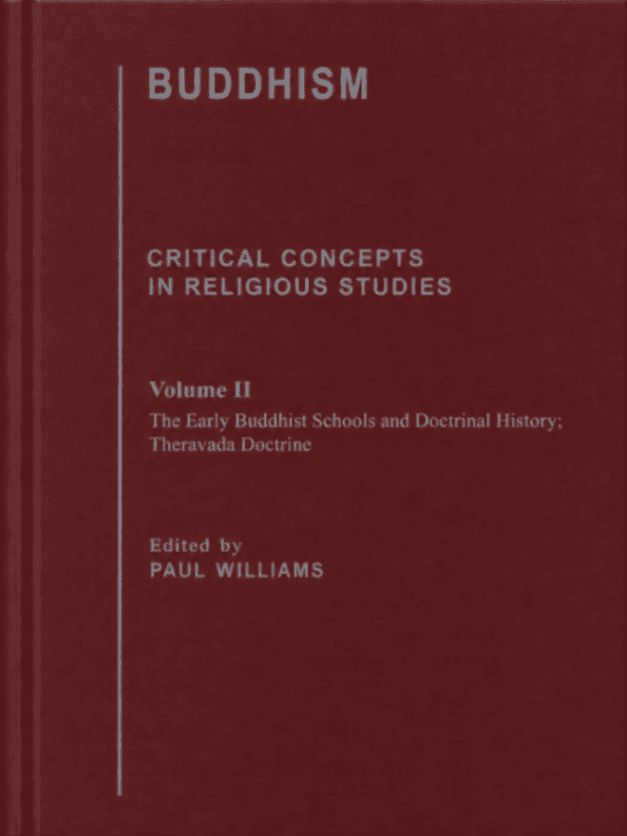
Buddhism: Critical Concepts in Religious Studies, Volume II
Introduction
Volume II of Buddhism: Critical Concepts in Religious Studies provides an important bridge between the historical study of the early Buddhist community and the doctrinal study of Theravāda Buddhism. Rather than presenting Buddhist schools as fixed entities that emerged fully formed after the Buddha’s death, the selected studies reveal a gradual and contested process shaped by Vinaya interpretation, monastic organization, political patronage, doctrinal disagreement, meditation theory, and later historiographical reconstruction. At the same time, the volume demonstrates the doctrinal breadth of Theravāda Buddhism through studies of jhāna, compassion, cosmology, selfhood, Buddha bodies, and devotional practice. By combining historical, philological, doctrinal, sociological, and philosophical approaches, the collection offers a valuable scholarly foundation for understanding the transition from the early Buddhist community to differentiated Buddhist schools and mature Theravāda traditions.
Heinz Bechert opens the collection with studies of the Theravāda Saṅgha and the historical formation of Buddhist sects. His analysis emphasizes that the development of the monastic community cannot be separated from political institutions, royal patronage, ordination lineages, Vinaya regulation, and repeated movements of sāsana reform. In Sri Lanka and Southeast Asia, the history of Theravāda Buddhism was therefore closely bound to changing relationships between the Saṅgha and the state. The discussion further shows the importance of valid upasampadā lineages, nikāya organization, and reform movements in maintaining the institutional continuity of Theravāda monasticism.
L. S. Cousins contributes three studies dealing with Buddhist jhāna, the “five points” associated with the origins of Buddhist schools, and the problem of person and self. His work on jhāna examines meditative absorption on the basis of Pāli sources, while his historical studies contribute to the reconstruction of early Buddhist sectarian development.
Rupert Gethin explores the relationship between cosmology and meditation, tracing continuities and transformations from the Aggañña-sutta into Mahāyāna traditions. R. F. Gombrich examines kindness and compassion as means to nirvāṇa, highlighting the soteriological importance of attitudes and practices often treated primarily as ethical virtues. Paul Griffiths then addresses a major problem in Theravāda meditation theory: the relationship between concentration and insight, or samatha and vipassanā.
The historical emergence of Buddhist schools is further investigated by Charles Hallisey, Charles S. Prebish, and Jan Nattier. Hallisey studies Buddhist councils both as historical events and as interpretive ideas within Theravāda tradition. Prebish revisits the śaikṣa-dharmas in relation to Mahāsāṃghika origins, while Nattier and Prebish examine the beginnings of Buddhist sectarianism. These studies demonstrate the methodological difficulty of reconstructing early Buddhist institutional divisions from later textual and historiographical traditions.
Frank E. Reynolds investigates the several bodies of the Buddha within Theravāda tradition, questioning overly simple assumptions that theories of multiple Buddha bodies belong only to Mahāyāna. Lambert Schmithausen examines the relationship between spiritual practice and philosophical theory, while Robert H. Sharf critically analyzes Buddhist Modernism and the modern rhetoric surrounding meditative experience.
The volume concludes with John Strong’s study of devotional offering in Buddhist Avadāna literature. Strong analyzes offering through physical and doctrinal dimensions, showing how acts of devotion can transform the devotee’s relation to the Buddha and shape future soteriological outcomes. His analysis connects physical offerings, aspiration (praṇidhāna), the Buddha’s rūpakāya and dharmakāya, and the religious logic of merit and future attainment.
Copyright Notice
This material is provided solely for academic research, study, and religious practice purposes under Article 25 of Vietnam's Intellectual Property Law. Reproduction, distribution, or commercial use is strictly prohibited.
If you are the author, translator, publisher, or rights holder and believe this content has been posted without proper authorization, please contact us and we will promptly review and remove or restrict access.
Documents
Buddhism: Critical Concepts in Religious Studies, Volume II
14.2 MB
Series: Buddhism: Critical Concepts in Religious Studies
Select a volume to see details or navigate between parts.
Buddhism: Critical Concepts in Religious Studies, Volume II
Keywords
Sách cùng tác giả
Sách đọc nhiều nhất
The Buddha’s Ancient Path
Piyadassi Thera
The Questions of King Milinda, Part II
F. Max Müller (Editor)

A Taste of Freedom
Venerable Ajahn Chah / Phra Bodhinyana Thera
Buddhist Meditation: An Anthology of Texts from the Pāli Canon
Sarah Shaw (General Editors: Charles S. Prebish and Damien Keown)