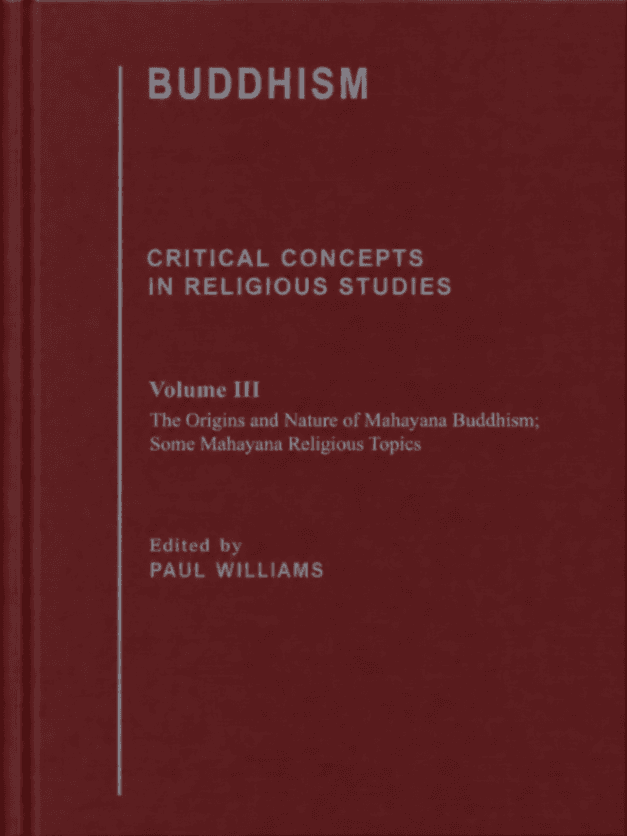
Buddhism: Critical Concepts in Religious Studies, Volume III
Introduction
Volume III of Buddhism: Critical Concepts in Religious Studies provides a critical reassessment of the emergence and nature of Mahāyāna Buddhism. Its principal strength lies in refusing a single explanatory model. Rather than assuming that Mahāyāna began as a discrete school, lay movement, stūpa cult, or doctrinal revolution, the selected studies examine several overlapping processes through which new texts, practices, ideals, and communities gradually developed within the wider Buddhist tradition. Particular attention is given to the bodhisattva path, Buddha-recollection, new conceptions of the Buddha and dharmakāya, stūpa devotion, scriptural revelation, gender, and the self-understanding of early Mahāyāna practitioners. The concluding problem of definition is especially significant: the volume demonstrates that “Mahāyāna Buddhism” is itself a scholarly category whose historical boundaries require careful qualification. It is therefore an essential research resource for understanding both the origins of Mahāyāna and the methodological challenges involved in reconstructing its early history.
L. S. Cousins opens the volume by reassessing the terms Sākiyabhikkhu/Sākyabhikkhu/Sākyabhikṣu and questioning whether they can legitimately be used as markers of a specifically Mahāyāna identity. His analysis of Pāli, Sanskrit, and epigraphic evidence argues that these expressions commonly meant simply “Buddhist monk,” rather than indicating membership in a distinct Mahāyāna movement. The study therefore challenges attempts to reconstruct early Mahāyāna communities from terminology in inscriptions alone.
Florin Deleanu examines the relationship between meditation and the beginnings of Mahāyāna, while Richard Gombrich considers the broader question of how Mahāyāna arose. Paul Harrison contributes a major cluster of studies on early Mahāyāna, including buddhānusmṛti in the Pratyutpannabuddhasaṃmukhāvasthitasamādhi-sūtra, early Mahāyāna self-image and identity, the nature of the dharmakāya, and the methodological difficulties involved in searching for the origins of the Great Vehicle.
Akira Hirakawa investigates the influential thesis connecting the rise of Mahāyāna with stūpa worship. This approach places ritual, cultic practice, lay devotion, and institutional change alongside purely doctrinal explanations of Mahāyāna origins. Étienne Lamotte’s extensive study of Mañjuśrī explores one of the most prominent bodhisattvas of Mahāyāna Buddhism, while Lewis R. Lancaster examines what he describes as the oldest Mahāyāna sūtra and its significance for reconstructing Buddhist historical development.
Graeme MacQueen’s study of inspired speech in early Mahāyāna Buddhism considers how new scriptural revelation and religious authority were conceptualized. Nancy Schuster examines representations of women and the transformation of the female body within bodhisattva narratives in several Mahāratnakūṭa sūtras, thereby highlighting gender as an important dimension of Mahāyāna religious imagination and soteriology.
The volume concludes with Jonathan A. Silk’s important methodological essay, “What, if anything, is Mahayana Buddhism? Problems of definitions and classifications.” Silk challenges the assumption that Mahāyāna can be understood as a single, clearly bounded sect or institution. The evidence examined in the volume suggests instead that what later came to be called Mahāyāna initially developed within broader Buddhist monastic environments, where Mahāyāna texts and practices could coexist with Vinaya, Abhidharma, Jātaka, meditation, and other forms of Buddhist learning and practice.
Copyright Notice
This material is provided solely for academic research, study, and religious practice purposes under Article 25 of Vietnam's Intellectual Property Law. Reproduction, distribution, or commercial use is strictly prohibited.
If you are the author, translator, publisher, or rights holder and believe this content has been posted without proper authorization, please contact us and we will promptly review and remove or restrict access.
Documents
Buddhism: Critical Concepts in Religious Studies, Volume III
19.6 MB
Series: Buddhism: Critical Concepts in Religious Studies
Select a volume to see details or navigate between parts.
Buddhism: Critical Concepts in Religious Studies, Volume III
Keywords
Sách cùng tác giả
Sách đọc nhiều nhất
The Buddha’s Ancient Path
Piyadassi Thera
The Questions of King Milinda, Part II
F. Max Müller (Editor)

A Taste of Freedom
Venerable Ajahn Chah / Phra Bodhinyana Thera
Buddhist Meditation: An Anthology of Texts from the Pāli Canon
Sarah Shaw (General Editors: Charles S. Prebish and Damien Keown)