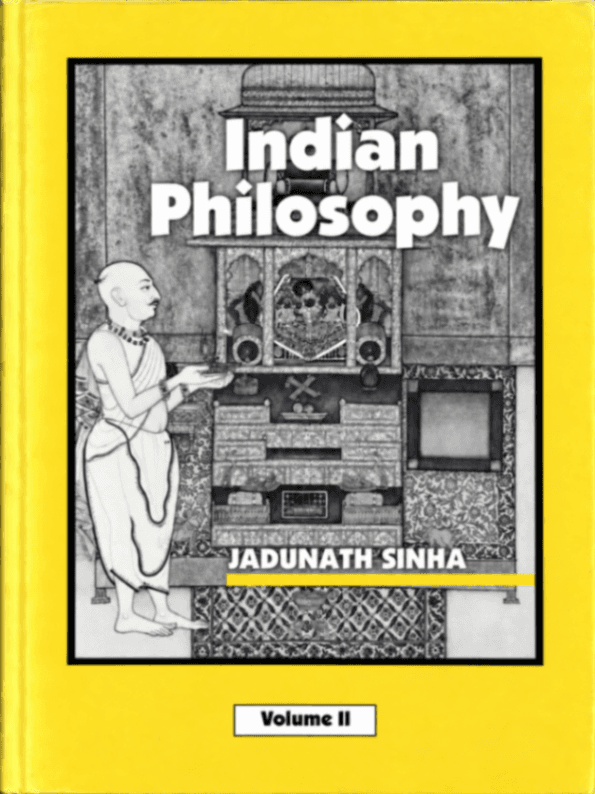
Indian Philosophy, Volume 2
Introduction
Volume 2 treats the Sāṃkhya, Yoga, Jainism, Early Buddhism, Buddhist schools, Vedānta systems, Vaiṣṇava traditions, Śaivism, and Śāktism in substantial detail.
The first chapter, “The Sāṃkhya Philosophy,” gives a detailed account of Sāṃkhya metaphysics, epistemology, psychology, ethics, liberation, and theology. Sinha analyzes satkāryavāda, pariṇāmavāda, prakṛti, the three guṇas, cosmic evolution, the distinction between puruṣa and prakṛti, the role of buddhi, ahaṃkāra, manas, and the senses, the sources and validity of knowledge, bondage, suffering, and mokṣa. The chapter concludes with a critical evaluation of Sāṃkhya dualism and its relation to competing Indian systems.
Chapter II, “The Yoga Philosophy,” builds upon Sāṃkhya metaphysics but adds theism and a distinctive discipline of spiritual practice. Sinha discusses substance and modes, causal theory, the relation between Sāṃkhya and Yoga, the role and proofs of God (Īśvara), valid knowledge, error, mind and mental modifications, samādhi, karma, transmigration, and liberation. The uploaded portion reaches the analysis of citta and its mental modes, showing Sinha’s characteristic integration of metaphysics, epistemology, and psychology.
The remainder of the volume, as shown in the Contents, proceeds through Jaina philosophy, Early Buddhism, the major Buddhist schools, the philosophical background of Vedānta, Śaṅkara’s Advaita Vedānta, the theistic Vedānta traditions of Rāmānuja, Madhva, Nimbārka, Vallabha, and Caitanya, and finally Śaivism and Śāktism. The book thus presents a broad comparative account of the principal metaphysical, epistemological, theological, and soteriological systems of classical Indian philosophy.
Main Headings:
The Sāṃkhya Philosophy
The Yoga Philosophy
The Jaina Philosophy
Early Buddhism
The Schools of Buddhism
The Background of the Vedānta
The Advaita Vedānta of Śaṅkara
The Background of the Theistic Vedānta
The Philosophy of Viśiṣṭādvaita
The Dvaitavāda of Madhva
Dvaitādvaitavāda of Nimbārka
Śuddhādvaitavāda of Vallabha
Acintyabhedābhedavāda of Caitanya
Śaivism and Śāktism
Copyright Notice
This material is provided solely for academic research, study, and religious practice purposes under Article 25 of Vietnam's Intellectual Property Law. Reproduction, distribution, or commercial use is strictly prohibited.
If you are the author, translator, publisher, or rights holder and believe this content has been posted without proper authorization, please contact us and we will promptly review and remove or restrict access.
Documents
Indian Philosophy, Volume 2
309.5 MB
Series: Indian Philosophy
Select a volume to see details or navigate between parts.
Keywords
Sách cùng tác giả
Sách đọc nhiều nhất
The Buddha’s Ancient Path
Piyadassi Thera
The Questions of King Milinda, Part II
F. Max Müller (Editor)

A Taste of Freedom
Venerable Ajahn Chah / Phra Bodhinyana Thera
Buddhist Meditation: An Anthology of Texts from the Pāli Canon
Sarah Shaw (General Editors: Charles S. Prebish and Damien Keown)