
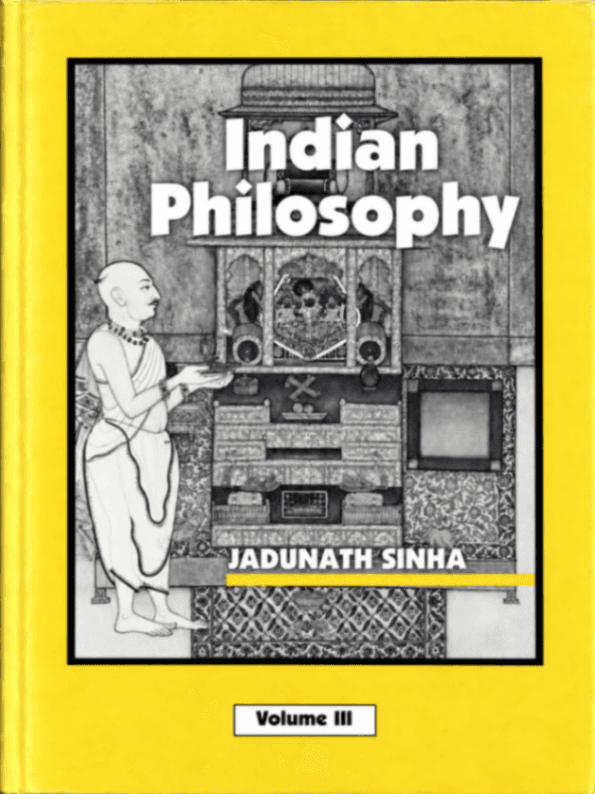
Indian Philosophy, Volume 3
Introduction
Jadunath Sinha presents this volume as a continuation of his broader history of Indian philosophy. Whereas the earlier volumes deal with the Upaniṣads, major orthodox systems, Buddhism, Jainism, and earlier Vedānta traditions, Volume III gives extended attention to Bhāskara, several Śaiva philosophical schools, and post-Śaṅkara Advaita Vedānta. In the author’s own framing, the work seeks not merely to describe doctrines but to examine their philosophical problems, internal arguments, criticisms of rival systems, and practical implications.
A distinctive strength of the volume is its treatment of Śaivism as a sophisticated philosophical tradition rather than solely as a religious or sectarian phenomenon. The discussion of Pratyabhijñā Śaivism, in particular, addresses absolute consciousness, the powers of Śiva, cosmological manifestation, the structure of individual consciousness, bondage, spiritual discipline, and recognition of one’s identity with the Absolute. Sinha similarly distinguishes the metaphysical positions of Pāśupata, Śaiva Siddhānta, Śrīkaṇṭha, and Vīra Śaivism.
The treatment of post-Śaṅkara Advaita is equally systematic. Sinha devotes separate discussions to the nature of Brahman, the empirical world, liberation, and epistemology, allowing the reader to see how later Advaitins refined, defended, and debated central Vedāntic concepts such as avidyā, māyā, jīva, Īśvara, causality, and knowledge.
The opening section discusses Bhāskara, particularly his understanding of Brahman, the world, the individual self, causation, divine agency, bondage, and liberation. The largest early portion of the volume is devoted to the Pratyabhijñā school of Kashmir Śaivism, where Sinha explores Śiva as absolute consciousness, Śakti, the manifestation of the universe, individual consciousness, māyā, the categories of reality, bondage, recognition, and liberation. Subsequent chapters treat Pāśupata philosophy, Śaiva Siddhānta, Śrīkaṇṭha’s Śaiva Viśiṣṭādvaita, and Vīra Śaivism, illustrating the considerable doctrinal diversity within Śaiva traditions.
The latter half turns to post-Śaṅkara Advaita Vedānta. It systematically examines Brahman, Īśvara, jīva, avidyā, māyā, the ontological status of the world, causation, perception, inference, verbal testimony, knowledge, meditation, and liberation. A substantial epistemological discussion addresses the validity of knowledge, error, perception, inference, comparison, presumption, non-apprehension, and the relation between empirical and transcendental knowledge. Sinha concludes by critically comparing the principal systems treated throughout the volume, making the book both a historical survey and a sustained work of comparative Indian philosophy.
Contents
Chapter I — The Philosophy of Bhāskara
Chapter II — The Pratyabhijñā School of Śaivism
Chapter III — The Philosophy of the Pāśupata
Chapter IV — The Śaiva Siddhānta
Chapter V — Śaiva Viśiṣṭādvaitavāda of Śrīkaṇṭha
Chapter VI — The Philosophy of Vīra Śaivism
Chapter VII — Problems of Post-Śaṅkara Advaita Vedānta I: Brahman
Chapter VIII — World
Chapter IX — Liberation
Chapter X — Post-Śaṅkara Advaita Epistemology
Chapter XI — Critique
Copyright Notice
This material is provided solely for academic research, study, and religious practice purposes under Article 25 of Vietnam's Intellectual Property Law. Reproduction, distribution, or commercial use is strictly prohibited.
If you are the author, translator, publisher, or rights holder and believe this content has been posted without proper authorization, please contact us and we will promptly review and remove or restrict access.
Documents
Indian Philosophy, Volume 3
212.9 MB
Series: Indian Philosophy
Select a volume to see details or navigate between parts.
Keywords
Sách cùng tác giả
Sách đọc nhiều nhất
The Buddha’s Ancient Path
Piyadassi Thera
The Questions of King Milinda, Part II
F. Max Müller (Editor)

A Taste of Freedom
Venerable Ajahn Chah / Phra Bodhinyana Thera
Buddhist Meditation: An Anthology of Texts from the Pāli Canon
Sarah Shaw (General Editors: Charles S. Prebish and Damien Keown)