
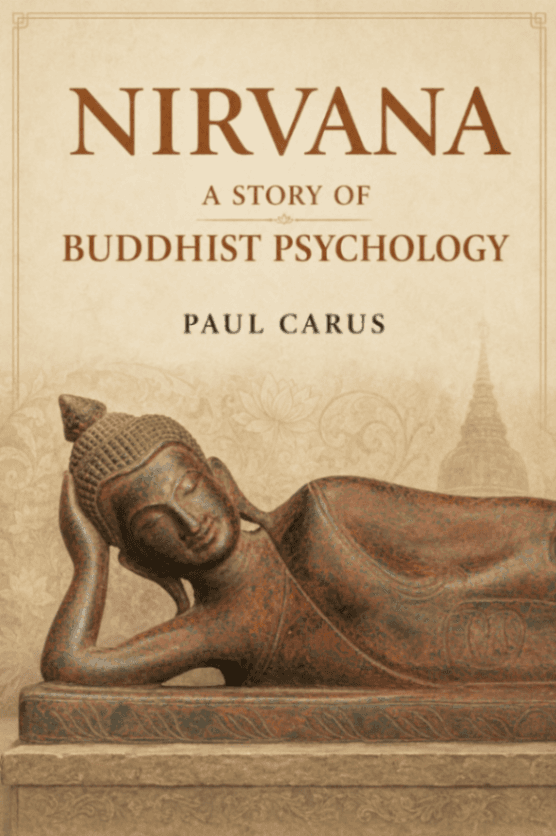
English
Nirvana: A Story of Buddhist Psychology
Paul Carus
English
Book
Kegan Paul, Trench, Trübner & Co., Ltd., London
1902
104 pages
5.3 MB
Introduction
The work opens with a Preamble that introduces the Buddha as the Enlightened One who teaches the origin of suffering and the path to liberation. The first narrative movement, “Sudatta, the Brahman Youth, at the Plow,” presents Sudatta’s encounter with Anuruddha and introduces the ethical problem of violence toward living beings. “The Story of the Hare” explains self-sacrifice, compassion, and the Bodhisatta path. “What is Nirvana?” gives the central doctrinal explanation of Nirvana as the extinction of craving, hatred, illusion, and mental disturbance. “Begging for Alms” and “The Wedding” place Buddhist discipline in contact with Brahmanical social life. “A Sermon on Happiness” and “The Controversy” explore the contrast between ritual, caste-based religion, and Buddhist insight into non-self. “The Katha-Upanishad” and “The Immortality of Deeds” further examine the relation between the soul, action, and moral continuity. “The Epidemic,” “Copying the Manuscript,” “Young Subhuti,” and “The Blessed One” bring the narrative toward its spiritual resolution, showing how Buddhist teaching transforms grief, doubt, and inherited belief into insight, compassion, and devotion to the path.
Copyright Notice
This material is provided solely for academic research, study, and religious practice purposes under Article 25 of Vietnam's Intellectual Property Law. Reproduction, distribution, or commercial use is strictly prohibited.
If you are the author, translator, publisher, or rights holder and believe this content has been posted without proper authorization, please contact us and we will promptly review and remove or restrict access.
Documents
Nirvana: A Story of Buddhist Psychology
5.3 MB
Keywords
NirvanaBuddhist psychologyNon-selfKarmaCompassionImpermanenceBuddhist narrative.
Sách cùng tác giả
Sách đọc nhiều nhất
The Buddha’s Ancient Path
Piyadassi Thera
Book·10.7 MB
229 pages1979223
The Questions of King Milinda, Part II
F. Max Müller (Editor)
Book·20.8 MB
427 pages1894208

A Taste of Freedom
Venerable Ajahn Chah / Phra Bodhinyana Thera
Book·1.2 MB
104 pages1980207
Buddhist Meditation: An Anthology of Texts from the Pāli Canon
Sarah Shaw (General Editors: Charles S. Prebish and Damien Keown)
Book·17.5 MB
253 pages2006204