English
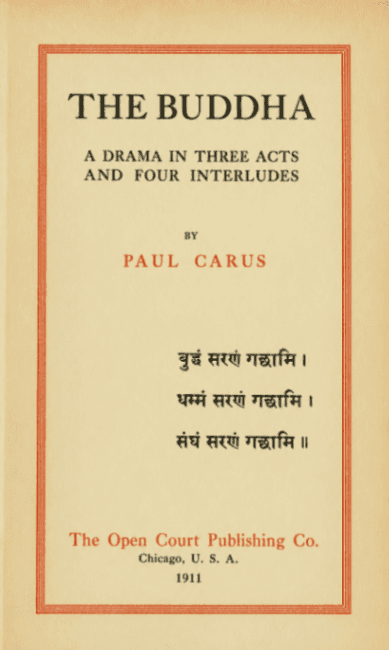
The Buddha: A Drama in Three Acts and Four Interludes
Paul Carus
English
Book
The Open Court Publishing Co.
1911
84 pages
3.5 MB
Introduction
The book opens with brief directions for staging, a cast of characters, and a short glossary of Buddhist and Indic terms such as Buddha, Bodhi, Bodhisatta, Tathagata, Nirvana, Kapilavatthu, Savatthi, Jetavana, Magadha, and Uruvela. These materials show that the work is designed both as a theatrical script and as an accessible Buddhist dramatic narrative.
Act I
Act I takes place mainly in the royal palace and garden of Kapilavatthu. King Suddhodana and his ministers are concerned about Siddhattha’s melancholy, his rejection of caste privilege, sacrifice, and conventional religious authority. Siddhattha reflects deeply on old age, sickness, death, impermanence, and the suffering of worldly life. Despite the emotional appeals of Yasodhara, Rahula, Kala Udayin, and his father, he resolves to leave the palace and seek saving truth. The act ends with Siddhattha’s renunciation and departure into homelessness.
Act II
Act II presents Siddhattha’s spiritual quest after renunciation. Through reports and dramatic visions, the text describes his wandering life, his meeting with King Bimbisara, his study with teachers, his severe asceticism, and his eventual rejection of extreme self-mortification. The central movement of the act is the enlightenment scene under the Bodhi tree, where Siddhattha resists Mara’s temptations and realizes the truth of suffering, its cause, its cessation, and the path to liberation.
Act III
Act III focuses on the Buddha’s public mission. The drama introduces King Bimbisara, Devadatta, Ambapali, Anatha Pindika, Prince Jeta, and the establishment of Jetavana. The Buddha is portrayed as a teacher of righteousness, peace, goodwill, and liberation. He returns to the Sakyas not as a prince seeking power, but as the Buddha. The drama ends with reconciliation, refuge in the Buddha’s teaching, and the affirmation of a spiritual kingdom based on truth rather than political authority.
Interludes
The four interludes function as visual transitions between the major acts. They show important episodes such as Siddhattha begging for food, his meeting with Bimbisara, his rescue from starvation, the first preaching of the Dharma, the conversion of followers, the donation of Jetavana, and the political tension between Magadha and the Sakyas.
Overall, the drama presents the Buddha’s life as a movement from palace life to renunciation, from spiritual struggle to enlightenment, and from personal awakening to universal teaching. Its central themes are impermanence, suffering, compassion, moral courage, renunciation, and the founding of a spiritual kingdom of truth.
Copyright Notice
This material is provided solely for academic research, study, and religious practice purposes under Article 25 of Vietnam's Intellectual Property Law. Reproduction, distribution, or commercial use is strictly prohibited.
If you are the author, translator, publisher, or rights holder and believe this content has been posted without proper authorization, please contact us and we will promptly review and remove or restrict access.
Documents
The Buddha: A Drama in Three Acts and Four Interludes
3.5 MB
Keywords
The BuddhaBuddhist DramaSiddhattha GotamaEnlightenment.
Sách cùng tác giả
Sách đọc nhiều nhất
The Buddha’s Ancient Path
Piyadassi Thera
Book·10.7 MB
229 pages1979223
The Questions of King Milinda, Part II
F. Max Müller (Editor)
Book·20.8 MB
427 pages1894208

A Taste of Freedom
Venerable Ajahn Chah / Phra Bodhinyana Thera
Book·1.2 MB
104 pages1980207
Buddhist Meditation: An Anthology of Texts from the Pāli Canon
Sarah Shaw (General Editors: Charles S. Prebish and Damien Keown)
Book·17.5 MB
253 pages2006204