
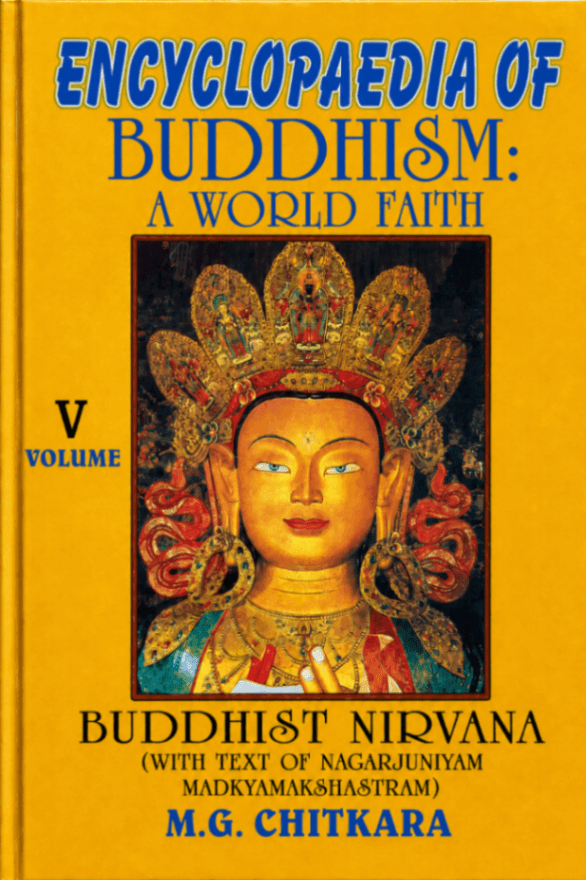
Encyclopaedia of Buddhism: A World Faith, Volume 5: Buddhist Nirvana (with Text of Nāgārjunīyam Madhyamakśāstram)
Introduction
The introductory section defines Nirvāṇa as the central goal of Buddhist religious practice and investigates its relationship with saṃsāra, craving, ego, ignorance, dependent origination, impermanence, non-self, and liberation. It stresses that Nirvāṇa cannot adequately be treated as either simple existence or non-existence, because such conceptual alternatives themselves belong to the dualistic framework that Buddhist realization seeks to transcend. The discussion further distinguishes Nirvāṇa from annihilationism and interprets liberation as the extinction of craving, attachment, and false constructions rather than the destruction of an independently existing person.
The subsequent chapters move from fundamental ethical and anthropological issues—“The Purpose of Human Life,” “Ego Free Living,” and “Anatta: No Soul”—to increasingly specialized discussions of Buddha-nature, the Four Noble Truths, dependent origination, saṃsāra, rebirth, meditation, karma, Bodhisattvahood, Dharma, compassion, social peace, and the Lotus Sūtra. The final chapters deal particularly with the philosophical meaning of Dharma and Nirvāṇa, followed by two appendices on Nāgārjuna: “Nāgārjuna’s Examination of Nirvana” and “Nāgārjuna’s Examination of Causality.”
Table of Contents
Foreword
Preface
Appreciation
Introduction
The Purpose of Human Life
Ego Free Living
Anatta: No Soul
Living Eternal Truth
Be Light unto Yourself
Man Delivers Himself
Become Natural
Live Buddhism Be Enlightened
The Buddha Nature
Trikaya related to Buddha Nature
Contentment the Greatest Bliss
Unfolding Self
Aham Brahmasmi
The Concept of Self in “Four Noble Truths”
Suffering and its Cessation
Compassion and Wisdom: Counter Negative Emotions
Ten Fetters of Human Passion
Dependent Origination
Freedom From Tanha: Nirvana
Desire: The Seed of Mind
Samsara is Nirvana & Nirvana is Samsara
Realizing True Self is Nirvana
The Path of Souls Leads To Nirvana
Nirvana is “Beyond Time & Space”
The Wise Realize Nirvana
Nirvana: Man Transcends Birth & Death
Dharmakaya, Nirvana: Two Sides of the same Coin
Arahant, The Saint Realizes Nirvana
Suchness to the Eternal Shores of Nirvana
Consumerism, Forget Nirvana
Love, Compassion: Way To World Peace
Parinirvana And Nirvana
Mahamudra Realisation
Summum Bonum of Life
Scientific Yogic Mind: Paves Way to Enlightenment
Meditation is a Way to Enlightenment
Love and Non-attachment
Jainism, Buddhism: to Ultimate Liberation
Brahmana, The Arahat Attains Nirvana
Enlightenment – Satori is Instant
Individual to World Peace
Peace and Re-incarnation
Karma, Reincarnation Binds the World Together
Liberation & Peace
Buddha in the Making: Bodhisattva
Bodhisattva Ideal
The Bodhisattva Deeds
Dharma Upholds Efforts
Morality: The Essence of Dhamma
Dhamma Leads To Nirvana
Dhamma: Not Religion
Dharma: A Concept of Socio-Spiritual Engineering
Love, Compassion: Motivation For Social Service
Buddhism: Admits Rebirth But Not Transmigration
Buddhism in the Changing World
Lotus Sutra: The Way to Peace
Lotus Sutra: Skill-in-Means
The Lotus Sutra: The Philosophy of Life
Appendix I: Nagarjuna’s Examination of Nirvana
Appendix II: Nagarjuna’s Examination of Causality
Copyright Notice
This material is provided solely for academic research, study, and religious practice purposes under Article 25 of Vietnam's Intellectual Property Law. Reproduction, distribution, or commercial use is strictly prohibited.
If you are the author, translator, publisher, or rights holder and believe this content has been posted without proper authorization, please contact us and we will promptly review and remove or restrict access.
Documents
Encyclopaedia of Buddhism: A World Faith, Volume 5: Buddhist Nirvana (with Text of Nāgārjunīyam Madhyamakśāstram)
358.7 MB
Series: Encyclopaedia of Buddhism: A World Faith
Select a volume to see details or navigate between parts.
Encyclopaedia of Buddhism: A World Faith, Volume 5: Buddhist Nirvana (with Text of Nāgārjunīyam Madhyamakśāstram)
Keywords
Sách đọc nhiều nhất
The Buddha’s Ancient Path
Piyadassi Thera
The Questions of King Milinda, Part II
F. Max Müller (Editor)

A Taste of Freedom
Venerable Ajahn Chah / Phra Bodhinyana Thera
Buddhist Meditation: An Anthology of Texts from the Pāli Canon
Sarah Shaw (General Editors: Charles S. Prebish and Damien Keown)