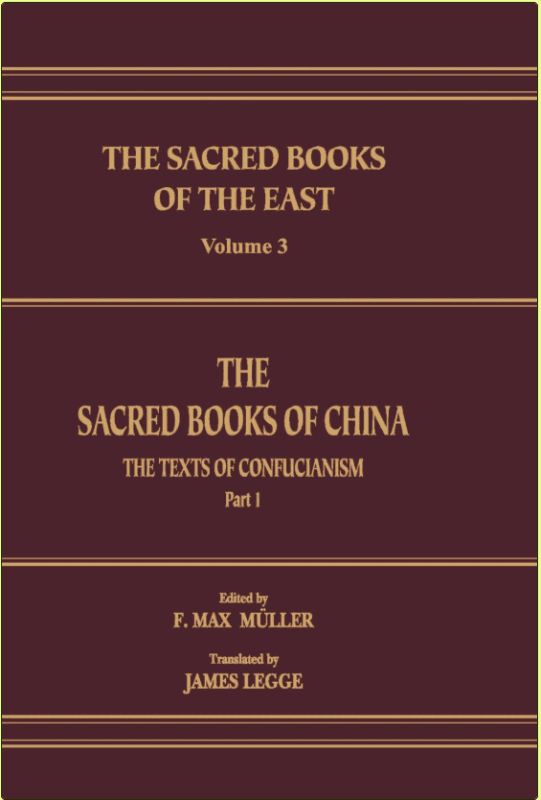
The Sacred Books of China: The Texts of Confucianism. Part I: The Shû King, The Religious Portions of the Shih King, The Hsiâo King
English

The Sacred Books of China: The Texts of Confucianism. Part I: The Shû King, The Religious Portions of the Shih King, The Hsiâo King

F. Max Müller (Editor)
English
Book
Oxford University Press Warehouse, London
1879
554 pages
54.9 MB

Introduction

The Preface frames the religious landscape of China through Confucianism, Taoism, and Buddhism. Legge gives priority to Confucianism as the principal religious and moral tradition of China and explains that the ancient Chinese classics do not claim divine revelation in the same sense as some other sacred literatures. Instead, their religious value lies in historical memory, moral teaching, ritual practice, reverence for Heaven, ancestral worship, and the formation of social order. The first major section, The Shû King, introduces the nature, history, recovery, and credibility of the Book of Historical Documents. Legge discusses the transmission of the text before and after Confucius, the destruction of classical literature under the Qin, the later recovery of the text under the Han, and the distinction between “modern text” and “old text” traditions. The translated documents focus on ancient rulers such as Yao, Shun, and Yu; dynastic legitimacy; royal virtue; flood control; the organization of territory; moral government; ministerial counsel; punishment; Heaven’s mandate; and the responsibility of rulers to secure social harmony. The second major section, The Shih, presents the religious portions of the Book of Poetry. Legge explains the name, contents, formation, textual transmission, and Confucian handling of the poetic collection. Rather than translating all 305 poems, this volume selects those that are especially relevant to ancient Chinese religion. The selected odes include sacrificial hymns, temple and altar songs, royal praise poems, major and minor odes of the kingdom, and state poems that reflect reverence for ancestors, Heaven, royal virtue, agricultural blessing, ritual music, and communal memory. The third major section, The Hsiao, introduces and translates the Classic of Filial Piety. Legge examines its title, authorship, Han recovery, textual preservation, and later criticism. The text presents filial piety not only as a family virtue, but as a comprehensive moral-political principle extending from the common people to officers, ministers, princes, and the Son of Heaven. It links personal conduct, family reverence, social responsibility, remonstrance, mourning, and governance into one integrated Confucian ethic. The volume concludes with a transliteration appendix, reflecting the editorial standards of the Sacred Books of the East series and supporting the representation of Chinese and other Oriental terms in Roman script.

Copyright Notice

This material is provided solely for academic research, study, and religious practice purposes under Article 25 of Vietnam's Intellectual Property Law. Reproduction, distribution, or commercial use is strictly prohibited.

If you are the author, translator, publisher, or rights holder and believe this content has been posted without proper authorization, please contact us and we will promptly review and remove or restrict access.

Documents

The Sacred Books of China: The Texts of Confucianism. Part I: The Shû King, The Religious Portions of the Shih King, The Hsiâo King

54.9 MB

Series: Sacred Books of the East

Select a volume to see details or navigate between parts.

T.3
Vol. 3

The Sacred Books of China: The Texts of Confucianism. Part I: The Shû King, The Religious Portions of the Shih King, The Hsiâo King

554 pages
T.11
395 pages
T.17
T.37
T.45
T.46
T.47
50/50 volumes published

Keywords

ConfucianismShû KingShih KingHsiao KingJames Leggefilial pietyChinese classics.