English
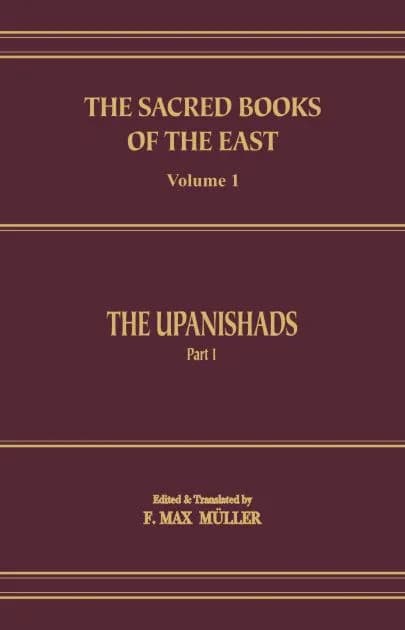
The Upanishads, Part I
F. Max Müller (Editor)
English
Book
Oxford University Press Warehouse, London
1879
447 pages
20.9 MB
Introduction
The volume begins with the general preface to the Sacred Books of the East, where Müller explains the scholarly purpose of the series: to provide complete, faithful, and historically grounded translations of the major sacred texts of Asia. He cautions readers against romanticizing ancient religious texts and argues that they must be studied as historical documents, with both their philosophical depth and their textual difficulties fully acknowledged.
The introductory section to the Upanishads provides the intellectual framework for the translations. It traces the first known translation history of the Upanishads from Sanskrit into Persian under Dara Shukoh, then into Latin through Anquetil Duperron, and discusses their influence on European thought, especially Schopenhauer. Müller also examines the role of Rammohun Roy in modern Indian religious reform, highlighting how the Upanishads became a foundation for reinterpreting Hindu religious identity beyond ritualism and idolatry.
A major part of the introduction situates the Upanishads within Vedic literature. Müller explains their relation to the Saṃhitās, Brāhmaṇas, and Āraṇyakas, and presents them as belonging to Śruti, or revealed literature. The discussion distinguishes older Upanishads embedded in early Vedic textual layers from later independent or sectarian Upanishads. This section is important because it clarifies the historical status, authority, and philosophical significance of the Upanishads.
The book also includes technical sections on transliteration and pronunciation of Oriental alphabets, especially Sanskrit. These materials reflect the philological standards of the Sacred Books of the East project and support accurate reading of Sanskrit names, concepts, and textual references.
The translated texts form the core of the volume. The Chāndogya Upanishad receives the largest treatment and presents teachings on Om, meditation, sacrifice reinterpreted through knowledge, cosmology, Sat, Ātman, and the famous teaching “tat tvam asi.” The Talavakāra or Kena Upanishad explores the power behind speech, mind, breath, and perception, pointing toward Brahman as the hidden ground of consciousness. The Aitareya Āraṇyaka connects ritual, recitation, cosmology, and knowledge, preserving the transition from liturgical speculation to philosophical reflection. The Kaushītaki Brāhmaṇa Upanishad discusses the journey after death, prāṇa, consciousness, and the relation between life-force and ultimate reality. The Vājasaneyi Saṃhitā Upanishad, commonly known as the Īśā Upanishad, offers a compact synthesis of renunciation, action, knowledge, ignorance, self, and immortality.
Copyright Notice
This material is provided solely for academic research, study, and religious practice purposes under Article 25 of Vietnam's Intellectual Property Law. Reproduction, distribution, or commercial use is strictly prohibited.
If you are the author, translator, publisher, or rights holder and believe this content has been posted without proper authorization, please contact us and we will promptly review and remove or restrict access.
Documents
The Upanishads, Part I
20.9 MB
Series: Sacred Books of the East
Select a volume to see details or navigate between parts.
T.1
Vol. 1
The Upanishads, Part I
447 pages
T.2
T.3
T.4
381 pagesDetails
T.6
392 pagesDetails
T.7
Vol. 7
The Institutes of Vishnu393 pagesDetails
T.8
T.9
416 pagesDetails
T.10
431 pagesDetails
T.11
Vol. 11
Buddhist Suttas395 pagesDetails
T.12
T.13
445 pagesDetails
T.14
T.15
Vol. 15
The Upanishads, Part II448 pagesDetails
T.16
T.17
Vol. 17
Vinaya Texts, Part II494 pagesDetails
T.18
T.19
460 pagesDetails
T.20
497 pagesDetails
T.21
541 pagesDetails
T.22
421 pagesDetails
T.23
438 pagesDetails
T.24
Vol. 24
Pahlavi Texts, Part III453 pagesDetails
T.25
T.26
T.27
T.28
T.29
T.30
T.31
Vol. 31
The Zend-Avesta, Part III489 pagesDetails
T.32
T.33
432 pagesDetails
T.34
T.35
428 pagesDetails
T.36
427 pagesDetails
T.37
Vol. 37
Pahlavi Texts, Part IV564 pagesDetails
T.38
T.39
423 pagesDetails
T.40
357 pagesDetails
T.41
T.42
T.43
T.44
T.45
Vol. 45
Gaina Sûtras, Part II509 pagesDetails
T.46
Vol. 46
Vedic Hymns, Part II525 pagesDetails
T.47
Vol. 47
Pahlavi Texts, Part V328 pagesDetails
T.48
T.49
Vol. 49
Buddhist Mahāyāna Text699 pagesDetails
50/50 volumes published
Keywords
UpanishadsF. Max MüllerSacred Books of the EastVedāntaĀtmanBrahmanSanskrit literature.
Sách đọc nhiều nhất
The Buddha’s Ancient Path
Piyadassi Thera
Book·10.7 MB
229 pages1979223

A Taste of Freedom
Venerable Ajahn Chah / Phra Bodhinyana Thera
Book·1.2 MB
104 pages1980207
Buddhist Meditation: An Anthology of Texts from the Pāli Canon
Sarah Shaw (General Editors: Charles S. Prebish and Damien Keown)
Book·17.5 MB
253 pages2006204
The Book of the Gradual Sayings (Aṅguttara-Nikāya) or More-Numbered Suttas, Vol. I (Ones, Twos, Threes)
F. L. Woodward, M.A.
Book·14.8 MB
309 pages2000201